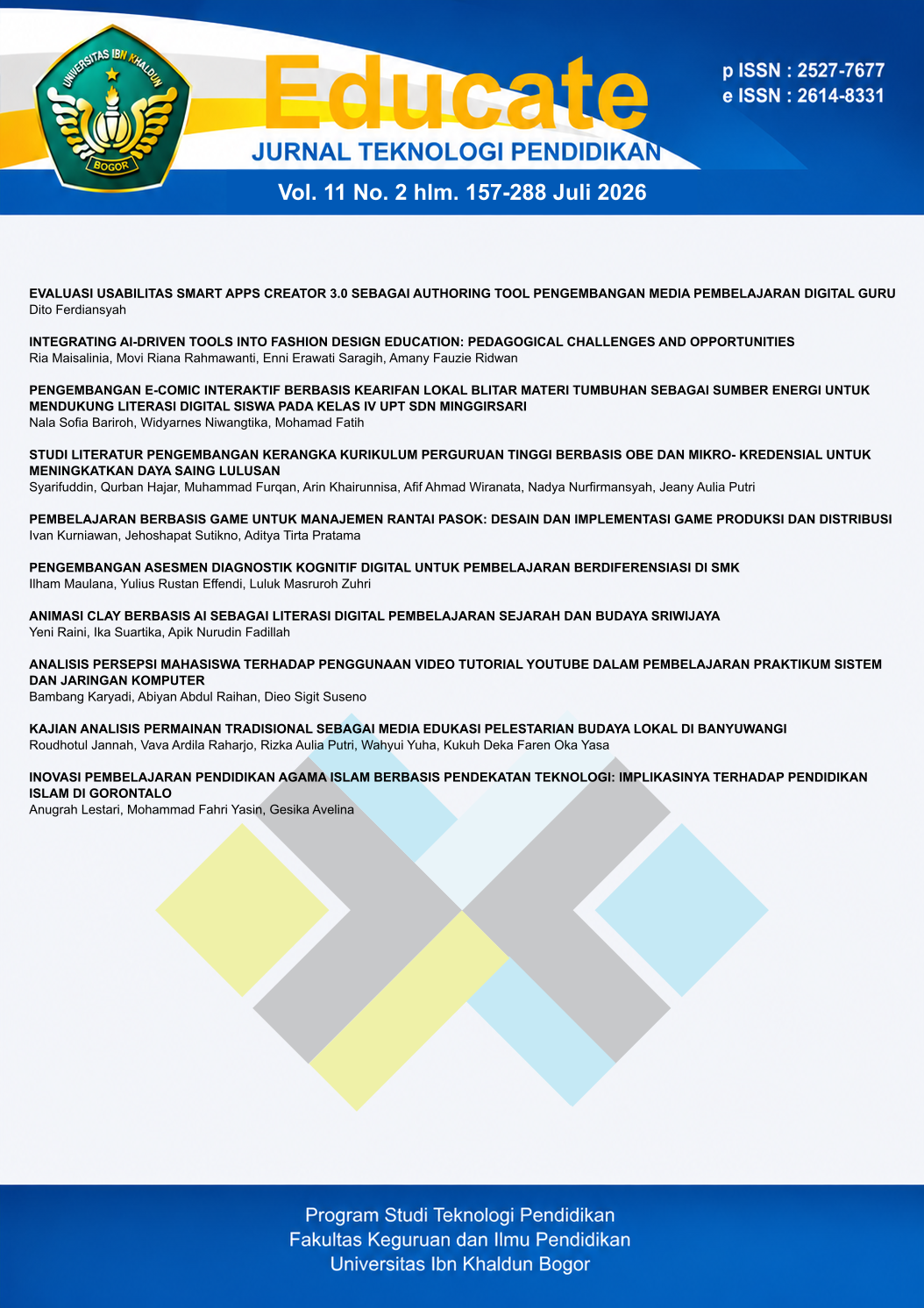
STUDI LITERATUR PENGEMBANGAN KERANGKA KURIKULUM PERGURUAN TINGGI BERBASIS OBE DAN MIKRO- KREDENSIAL UNTUK MENINGKATKAN DAYA SAING LULUSAN
DOI:
https://doi.org/10.32832/educate.v11i2.24033Kata Kunci:
Outcome-Based Education, Mikro-Kredensial, Kurikulum Perguruan Tinggi, Daya Saing Lulusan, MBKMAbstrak
Tekanan dunia kerja akibat digitalisasi yang masif memaksa perguruan tinggi untuk merekonstruksi orientasi kurikulumnya agar lulusan tidak hanya memiliki ijazah, melainkan juga kompetensi nyata yang dapat langsung dioperasikan di lapangan. Dua pendekatan yang kian mendapat perhatian serius dalam wacana akademik global adalah Outcome-Based Education (OBE) dan mikro-kredensial. Penelitian ini bertujuan membangun kerangka kurikulum integratif berbasis OBE dan mikro-kredensial melalui kajian literatur sistematis guna menjawab persoalan kesenjangan kompetensi lulusan perguruan tinggi di Indonesia. Kajian dilakukan dengan metode Systematic Literature Review (SLR) berpandu protokol PRISMA, menyaring 847 artikel dari Scopus, Web of Science, ERIC, dan Google Scholar terbitan 2019–2024 hingga diperoleh 42 artikel untuk disintesis. Temuan mengungkapkan bahwa penerapan OBE yang konsisten, saat dipadukan dengan unit mikro-kredensial yang terstruktur, secara signifikan memperkuat ketercapaian Capaian Pembelajaran Lulusan (CPL) sekaligus memperluas pengakuan kompetensi oleh industri. Sebagai produk sintesis, dikembangkan Kerangka Kurikulum OBE-Mikro-Kredensial (KK-OBE-MK) dengan empat komponen: perumusan CPL berbasis profil lulusan, pemetaan kurikulum melalui matriks CPL-CPMK, integrasi Micro-Credential Learning Unit (MCLU), dan asesmen autentik berbasis e-portfolio. Uji validasi konseptual mengonfirmasi bahwa kerangka ini koheren secara teoretis dan kompatibel dengan kebijakan Merdeka Belajar–Kampus Merdeka (MBKM) serta SN-Dikti.
Referensi
Alsubaie, M. A. (2016). Curriculum development: Teacher involvement in curriculum development. Journal of Education and Practice, 7(9), 106–107.
Anderson, L. W., & Krathwohl, D. R. (Eds.). (2001). A taxonomy for learning, teaching, and assessing: A revision of Bloom's taxonomy of educational objectives. Addison Wesley Longman.
Badan Pusat Statistik. (2023). Keadaan ketenagakerjaan Indonesia Agustus 2023. BPS RI.
Biggs, J., & Tang, C. (2011). Teaching for quality learning at university (4th ed.). Open University Press.
Creswell, J. W. (2014). Research design: Qualitative, quantitative, and mixed methods approaches (4th ed.). Sage Publications.
European Commission. (2022). European approach to micro-credentials for lifelong learning and employability. European Education Area.
Harden, R. M. (2002). Learning outcomes and instructional objectives: Is there a difference? Medical Teacher, 24(2), 151–155. https://doi.org/10.1080/0142159022020687
Indonesia Career Center Network. (2023). Laporan tahunan employabilitas lulusan perguruan tinggi 2023. ICCN.
Kemendikbudristek. (2020). Kebijakan Merdeka Belajar–Kampus Merdeka. Kementerian Pendidikan dan Kebudayaan.
Kemendikbudristek. (2022). Evaluasi implementasi program MBKM 2021/2022. Direktorat Pembelajaran dan Kemahasiswaan.
Kemendikbudristek. (2023). Peraturan Menteri Pendidikan, Kebudayaan, Riset, dan Teknologi Nomor 53 Tahun 2023 tentang Penjaminan Mutu Pendidikan Tinggi.
Lockyer, L., Heathcote, E., & Dawson, S. (2013). Informing pedagogical action: Aligning learning analytics with learning design. American Behavioral Scientist, 57(10), 1439–1459. https://doi.org/10.1177/0002764213479367
MarketsandMarkets. (2022). Micro-credentials market: Global forecast to 2028. MarketsandMarkets Research.
McKinsey Global Institute. (2021). The future of work after COVID-19. McKinsey & Company.
National University of Singapore. (2022). NUS lifelong learning annual report 2021/2022. NUS.
OECD. (2019). Future of education and skills 2030. OECD Publishing.
OECD. (2021). Education at a glance 2021: OECD indicators. OECD Publishing. https://doi.org/10.1787/b35a14e5-en
Oliver, B. (2019). Making micro-credentials work for learners, employers and providers. Journal of Teaching and Learning for Graduate Employability, 10(2), 1–4. https://doi.org/10.21153/jtlge2019vol10no2art806
Presiden Republik Indonesia. (2012). Peraturan Presiden Nomor 8 Tahun 2012 tentang Kerangka Kualifikasi Nasional Indonesia (KKNI).
Spady, W. G. (1994). Outcome-based education: Critical issues and answers. American Association of School Administrators.
UNESCO. (2022). A global framework for micro-credentials. UNESCO Publishing.
Wheelahan, L., & Moodie, G. (2021). Analysing micro-credentials in higher education: A Bernsteinian analysis. Journal of Curriculum Studies, 53(2), 212–228. https://doi.org/10.1080/00220272.2021.1887358
World Economic Forum. (2020). The future of jobs report 2020. WEF.
World Economic Forum. (2023). The future of jobs report 2023. WEF.
Unduhan
Diterbitkan
Cara Mengutip
Terbitan
Bagian
Lisensi
Hak Cipta (c) 2026 Syarifuddin, Qurban Hajar, Muhammad Furqan, Arin Khairunnisa, Afif Ahmad Wiranata, Nadya Nurfirmansyah, Jeany Aulia Putri

Artikel ini berlisensi Creative Commons Attribution 4.0 International License.
Penulis memberikan hak cipta karyanya kepada jurnal yang dilisensikan dengan CC-BY-SA or The Creative Commons Attribution–ShareAlike License yang memungkinkan orang lain untuk menggunakan karya dengan pengakuan kepengarangan karya dan publikasi awal dalam jurnal ini.