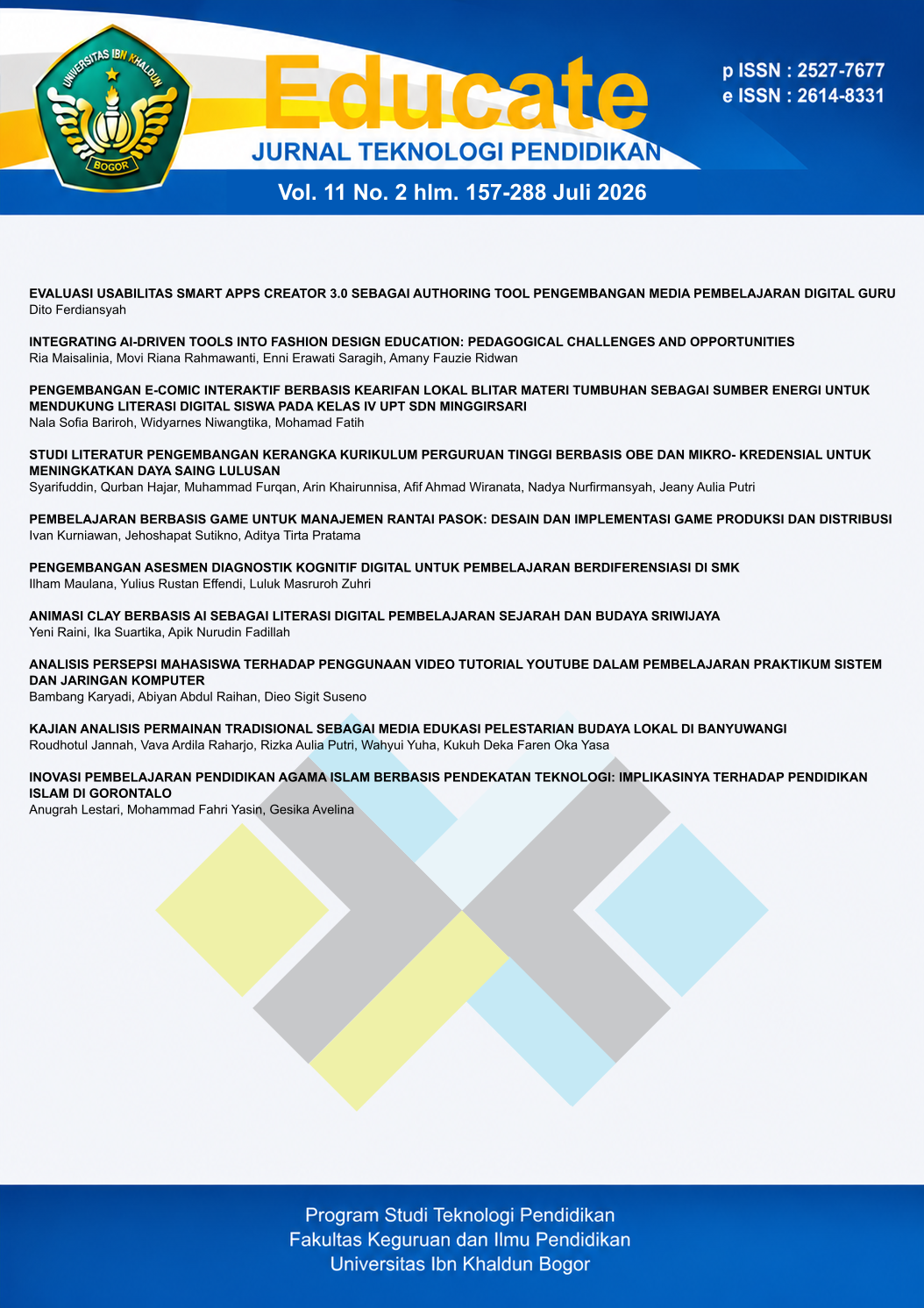
KAJIAN ANALISIS PERMAINAN TRADISIONAL SEBAGAI MEDIA EDUKASI PELESTARIAN BUDAYA LOKAL DI BANYUWANGI
DOI:
https://doi.org/10.32832/educate.v11i2.24747Kata Kunci:
Permainan Tradisional, Media Edukasi, Pelestarian Budaya BanyuwangiAbstrak
Pergeseran pola bermain anak dari permainan tradisional ke permainan modern (online games) di Kabupaten Banyuwangi membahayakan keberlanjutan nilai-nilai kearifan lokal Suku Osing. Penelitian ini bertujuan untuk menganalisis dan merekonstruksi lima jenis permainan tradisional Suku Osing yaitu egrang bambu, karetan/pelencatan, selodoran, krupuk-krupukan, dan engklek sebagai media edukasi interaktif yang efektif dalam pelestarian budaya lokal dan pembentukan karakter anak. Penelitian kualitatif dengan pendekatan deskriptif-analitis ini dilaksanakan di Desa Adat Kemiren, Kecamatan Glagah, Kabupaten Banyuwangi. Penentuan 16 orang informan dilakukan menggunakan teknik purposive sampling, terdiri atas tokoh adat/budayawan, guru sekolah dasar, orang tua, dan anak-anak usia SD. Pengumpulan data menggunakan pengamatan partisipatif pasif, wawancara mendalam, dan dokumentasi. Data dianalisis menggunakan model interaktif Miles, Huberman, dan Saldana (kondensasi data, penyajian data, dan penarikan kesimpulan) serta diuji keabsahannya melalui triangulasi sumber dan teknik.
Hasil penelitian menunjukkan bahwa kelima permainan tradisional Osing memiliki fungsi pedagogis holistik yang selaras dengan Teori Perkembangan Kognitif dan Sosial Vygotsky, Teori Pembentukan Karakter Lickona (moral knowing, feeling, action), serta Teori Piaget. Permainan ini terbukti secara nyata menginternalisasikan 18 nilai pembangun karakter bangsa, seperti kejujuran, kerja sama, kedisiplinan, kemandirian, dan kepedulian lingkungan. Berbeda dengan seni pertunjukan pasif, permainan tradisional memberikan tingkat partisipasi aktif yang tinggi bagi anak-anak. Sebagai media edukasi, permainan ini berhasil meningkatkan pemahaman kognitif budaya, membentuk sikap afektif positif, dan menumbuhkan partisipasi aktif (konatif) yang signifikan dalam menurunkan dominasi penggunaan gawai (gadget). Penelitian ini menghasilkan gagasan konsep baru berupa Community-Based Edu-Cultural Play Model (Model Edukasi Edu-Kultural Berbasis Komunitas) yang menegaskan pentingnya penanaman kearifan lokal secara subliminal dan partisipatif. Implikasi penelitian ini merekomendasikan pengintegrasian permainan tradisional Osing ke dalam kurikulum Muatan Lokal sekolah dasar serta penyediaan ruang terbuka bermain yang berkelanjutan di tingkat desa.
Referensi
Creswell, J. W., & Creswell, J. D. (2018). Research design: Qualitative, quantitative, and mixed methods approaches (5th ed.). SAGE Publications.
Jannah, Roudhotul., d.k.k. 2018. Nilai-Nilai Pembangun Karakter Dalam Permainan Anak Tradisional Using Di Banyuwangi, Prosiding Seminar Nasional. LPPM - Universitas Negeri Surabaya.
Jannah, Roudhotul., d.k.k. 2018. Nilai-Nilai Pembangun Karakter Dalam Permainan Anak Tradisional Using Di Banyuwangi, Prosiding Seminar Nasional. Laporan Penelitian Dosen Pemula. Tidak dipublikasikan.
Jannah, Roudhotul., d.k.k. 2019. Nilai-Nilai Pembangun Karakter: Permainan Tradisional Karetan/Pelencatan Suku Using di Banyuwangi. Volume 19 Nomor 2
Lickona, T. (1991). Educating for character: How our schools can teach respect and responsibility. Bantam Books.
Miles, M. B., Huberman, A. M., & Saldana, J. (2014). Qualitative data analysis: A methods sourcebook (3rd ed.). SAGE Publications.
Moleong, L. J. (2021). Metodologi penelitian kualitatif (Edisi Revisi). PT Remaja Rosdakarya.
Nugroho, A., & Handayani, S. (2022). Nilai-nilai karakter dalam permainan tradisional masyarakat Jawa. Jurnal Kebudayaan dan Nilai Sosial. Volume 5 Nomor 1.
Pratama, R. (2023). Integrasi seni pertunjukan Tari Gandrung dalam kurikulum pendidikan formal di Kabupaten Banyuwangi. Jurnal Pendidikan dan Kebudayaan, Volume1. Nomor 2.
Rahmawati, A., Susilo, B., & Fitriani, D. (2021). Optimasi permainan tradisional dalam mengintervensi keterampilan motorik kasar anak usia dini. Jurnal Pendidikan Anak Usia Dini, Volume 8, Nomor 2.
Setiawan, Wawan dan Setiabudi, Agung. (2020). Tingkat Partisipasi Masyarakat Berolahraga dengan Permainan Tradisional Di Kampoeng Batara. Prosiding Seminar Nasional.Fakultas Olahraga dan Kesehatan. Universitas PGRI Banyuwangi.
Sugiyono. (2019). Metode penelitian kuantitatif, kualitatif, dan R&D. Alfabeta.
Vygotsky, L. S. (1978). Mind in society: The development of higher psychological processes (M. Cole, V. John-Steiner, S. Scribner, & E. Souberman, Eds.). Harvard University Press.
Unduhan
Diterbitkan
Cara Mengutip
Terbitan
Bagian
Lisensi
Hak Cipta (c) 2026 Roudhotul Jannah, Vava Ardila Raharjo, Rizka Aulia Putri, Wahyui Yuha, Kukuh Deka Faren Oka Yasa

Artikel ini berlisensiCreative Commons Attribution-ShareAlike 4.0 International License.
Penulis memberikan hak cipta karyanya kepada jurnal yang dilisensikan dengan CC-BY-SA or The Creative Commons Attribution–ShareAlike License yang memungkinkan orang lain untuk menggunakan karya dengan pengakuan kepengarangan karya dan publikasi awal dalam jurnal ini.