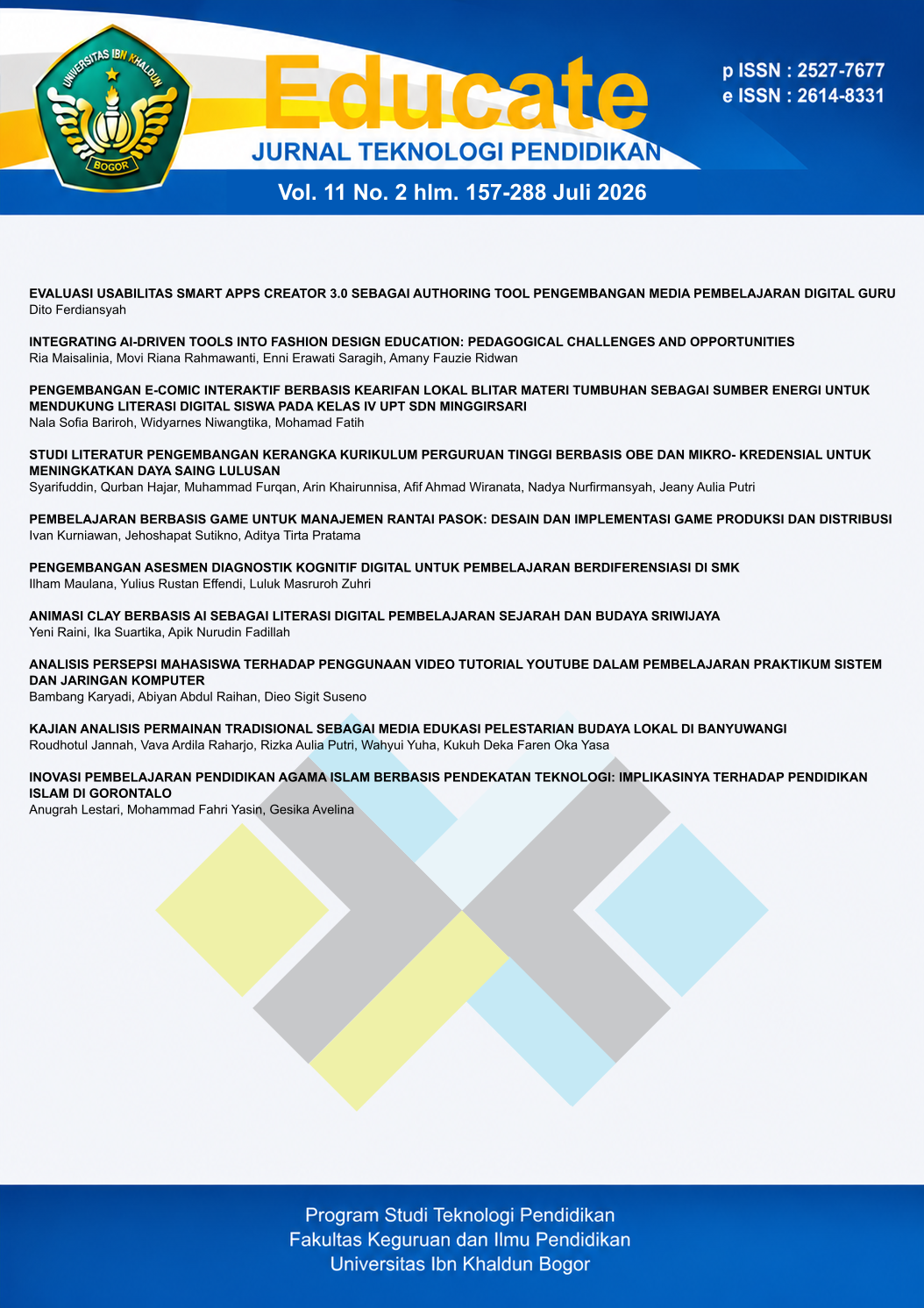
INTEGRATING AI-DRIVEN TOOLS INTO FASHION DESIGN EDUCATION: PEDAGOGICAL CHALLENGES AND OPPORTUNITIES
DOI:
https://doi.org/10.32832/educate.v11i2.23969Kata Kunci:
AI tools, Design Fashion Pedagogy, Challenges and OpportunitiesAbstrak
Despite the growing integration of AI-driven platforms across educational disciplines, limited present studies specifically examines the pedagogical challenges and opportunities these technologies present within creative fashion design education. Understanding this intersection is critically important as fashion institutions increasingly demand technologically proficient educators capable of navigating AI-driven learning environments. This study aimed to investigate the pedagogical challenges and opportunities of integrating AI-driven tools among pre-service fashion design teachers in university. Employing a sequential mixed-methods design, data were collected through a validated Likert-scale questionnaire administered to 30 pre-service teachers, supplemented by in-depth interviews with 15 participants, analyzed through Braun and Clarke's (2021) thematic framework. Results revealed an overall mean of 4.20 (High), with challenges yielding a collective mean of 4.15 (Very High), dominated by difficulty mastering tools within course timeframes (M=4.65), platform costs (M=4.47), and academic integrity concerns (M=4.29). Opportunity dimensions marginally surpassed challenges with a collective mean of 4.26 (Very High), led by AI as creative support (M=4.47) and enhanced industry readiness (M=4.29). These findings indicate that while there are some barriers significantly impede AI integration in the classroom. However, pre-service teachers maintain strongly positive orientations toward AI transformative pedagogical potential in fashion design pedagogy.
Referensi
Ayanwale, M. A., Adelana, O. P., Molefi, R. R., Adeeko, O., & Ishola, A. M. (2024). Examining artificial intelligence literacy among pre-service teachers for future classrooms. Computers and Education Open, 6. https://doi.org/10.1016/j.caeo.2024.100179
Braun, V., & Clarke, V. (2021). Thematic analysis: A practical guide to understanding and doing. Sage Publications.
Creswell, J. W. ., & Clark, V. L. Plano. (2018). Designing and conducting mixed methods research. SAGE.
Cui, T. (2026). Empowering sustainable design through AI and human-machine collaboration in fashion and industry. In Q. Wu, F. Shi, L. C. Jain, & V. E. Balas (Eds.), International Conference on Mechanical, Engineering, and Interaction Design (ICMEID 2025) (p. 267). SPIE. https://doi.org/10.1117/12.3088816
Ding, A. C. E., Shi, L., Yang, H., & Choi, I. (2024). Enhancing teacher AI literacy and integration through different types of cases in teacher professional development. Computers and Education Open, 6. https://doi.org/10.1016/j.caeo.2024.100178
Guo, Z., Zhu, Z., Li, Y., Cao, S., Chen, H., & Wang, G. (2023). AI Assisted Fashion Design: A Review. IEEE Access, 11, 88403–88415. https://doi.org/10.1109/ACCESS.2023.3306235
Han, W., & Xu, Y. (2026). “Make an Effort and Show Me the Love!” Understanding Consumer Aversion to AI Fashion Design Through the Lens of Schema Theory. Clothing and Textiles Research Journal, 44(1). https://doi.org/10.1177/0887302X251347924
Jung, D., & Suh, S. (2024). Enhancing Soft Skills through Generative AI in Sustainable Fashion Textile Design Education. Sustainability (Switzerland), 16(16). https://doi.org/10.3390/su16166973
Kim, J. (2024). Leading teachers’ perspective on teacher-AI collaboration in education. Education and Information Technologies, 29(7). https://doi.org/10.1007/s10639-023-12109-5
Kim, L., Jitpakdee, R., Praditsilp, W., & Issayeva, G. (2025). Does technological innovation matter to smart classroom adoption? Implications of technology readiness and ease of use. Journal of Open Innovation: Technology, Market, and Complexity, 11(1), 100448. https://doi.org/10.1016/j.joitmc.2024.100448
Lee, J., & Suh, S. (2024). AI Technology Integrated Education Model for Empowering Fashion Design Ideation. Sustainability (Switzerland), 16(17). https://doi.org/10.3390/su16177262
Li, Y., Tolosa, L., Rivas-Echeverria, F., & Marquez, R. (2025). Integrating AI in chemical education: Navigating UNESCO global guidelines, emerging trends, and its intersection with sustainable development goals. https://doi.org/10.26434/chemrxiv-2025-wz4n9-v2
Luo, M., Hu, X., & Zhong, C. (2025). The collaboration of AI and teacher in feedback provision and its impact on EFL learner’s argumentative writing. Education and Information Technologies, 30(12). https://doi.org/10.1007/s10639-025-13488-7
Malik, M. A., & Shah, R. (2025). AI teachers (AI-based robots as teachers): history, potential, concerns and recommendations. In Frontiers in Education (Vol. 10). https://doi.org/10.3389/feduc.2025.1541543
Mishra, P., & Koehler, M. J. (2006). Technological pedagogical content knowledge: A framework for teacher knowledge. Teachers College Record: The Voice of Scholarship in Education, 108(6), 1017–1054. https://doi.org/10.1111/j.1467-9620.2006.00684.x
Sutanto, J. E., Harianto, E., & Krisprimandoyo, D. A. (2024). Revolutionizing the runway: how technological and marketing innovation fuse market sensing on marketing performance in fashion industry. Cogent Business and Management, 11(1). https://doi.org/10.1080/23311975.2024.2334677
Tran, K., Nguyen, T., Tran, Y., Nguyen, A., Luu, K., & Nguyen, Y. (2022). Eco-friendly fashion among generation Z: Mixed-methods study on price value image, customer fulfillment, and pro-environmental behavior. PLoS ONE, 17(8 August). https://doi.org/10.1371/journal.pone.0272789
Vieira, S. M., Kaymak, U., & Sousa, J. M. C. (2010). Cohen’s kappa coefficient as a performance measure for feature selection. International Conference on Fuzzy Systems, 1–8. https://doi.org/10.1109/FUZZY.2010.5584447
Wheeldon, J. (2010). Mapping Mixed Methods Research: Methods, Measures, and Meaning. Journal of Mixed Methods Research, 4(2), 87–102. https://doi.org/10.1177/1558689809358755
Wu, X., & Li, L. (2024). An application of generative AI for knitted textile design in fashion. Design Journal, 27(2). https://doi.org/10.1080/14606925.2024.2303236
Zhang, Y., Tian, H., & Lu, J. (2025). The relationship between higher-order thinking and problem-solving skills development among pre-service teachers using generative AI: an analysis based on moderated mediation. BMC Psychology, 13(1). https://doi.org/10.1186/s40359-025-03404-6
Unduhan
Diterbitkan
Cara Mengutip
Terbitan
Bagian
Lisensi
Hak Cipta (c) 2026 Ria Maisalinia, Movi Riana Rahmawanti, Enni Erawati Saragih, Amany Fauzie Ridwan

Artikel ini berlisensi Creative Commons Attribution 4.0 International License.
Penulis memberikan hak cipta karyanya kepada jurnal yang dilisensikan dengan CC-BY-SA or The Creative Commons Attribution–ShareAlike License yang memungkinkan orang lain untuk menggunakan karya dengan pengakuan kepengarangan karya dan publikasi awal dalam jurnal ini.