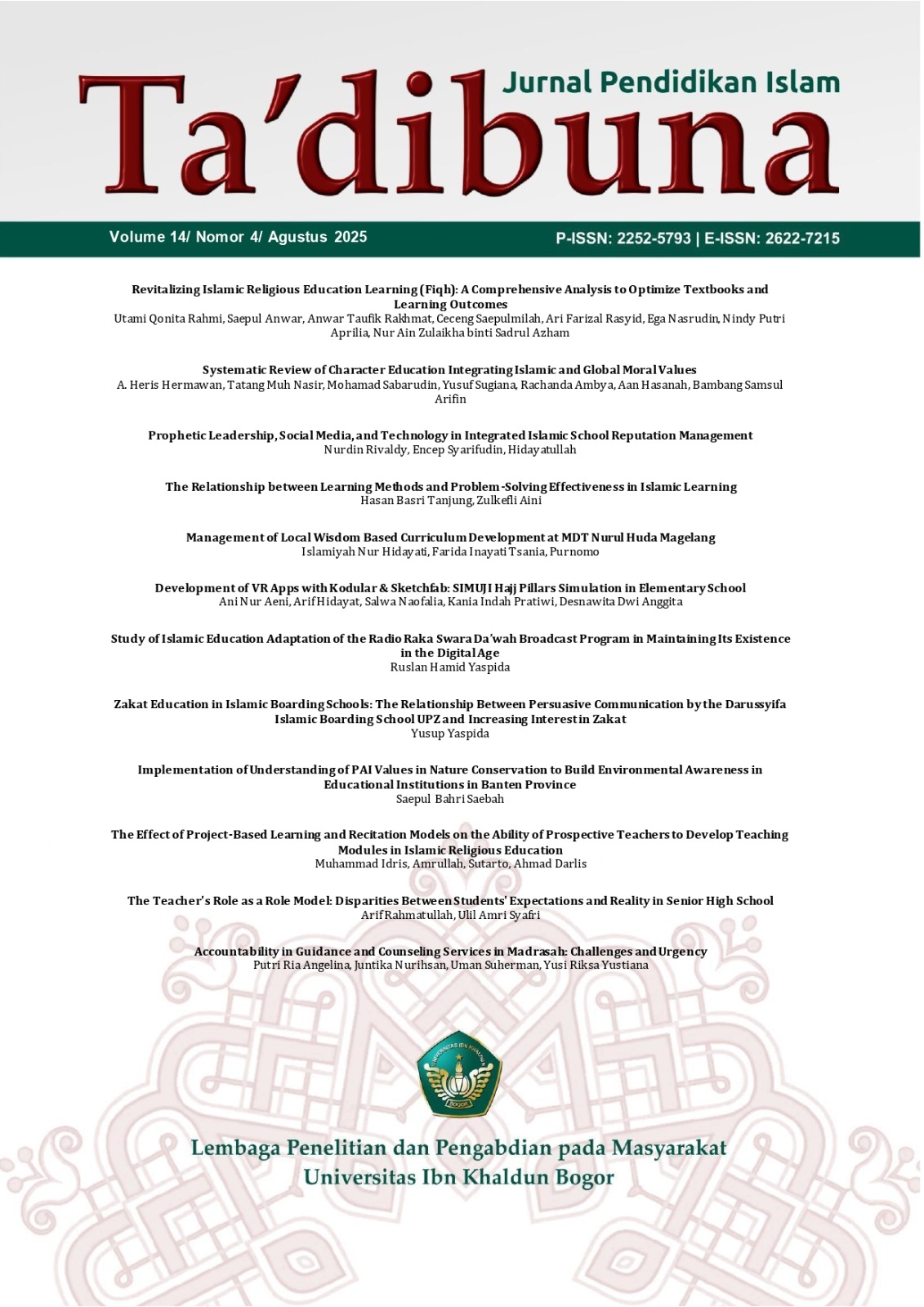
IMPLEMENTATION OF UNDERSTANDING OF PAI VALUES IN NATURE CONSERVATION TO BUILD ENVIRONMENTAL AWARENESS IN EDUCATIONAL INSTITUTIONS IN BANTEN PROVINCE
DOI:
https://doi.org/10.32832/tadibuna.v14i4.20864Abstract
Background: The issue of environmental degradation has become a major challenge around the world, as human-induced damage to ecosystems continues to worsen. Pollution, deforestation, species depletion, and weather changes are signs that environmental awareness in society is still low. This research aims: The purpose of this study is to understand the values in Islamic Religious Education (PAI) that relate to protecting nature and the environment as a religious and social responsibility. To find the ways in which Islamic Religious Education values are applied in the effort to protect the environment by various educational institutions in Banten Province. Creating strategic suggestions for developing an environmental education model based on Islamic values, so that it can be well integrated into the education system at the local and national levels. The method applied in this study is naturalistic qualitative, which focuses on naturally occurring circumstances in educational institutions (schools). The findings of this study show that Islamic values related to nature protection, such as tawhid, amanah, rahmatan lil 'alamin, and khilafah, have been incorporated into Islamic Religious Education (PAI) materials, especially on themes that discuss the relationship between humans and nature. In this case, PAI teachers function as drivers and supporters in instilling Islamic values related to the environment.
References
Abdurahman, A., Habibi, D. D., Muslim, B., Firdaus, P., & Rahmawati, D. (2025). Character Education. PT. Sonpedia Publishing Indonesia.
Agustin, M., Heryana, R., Heriyanto, I., Saldiana, R., & Wahab, A. (2023). Environment-based Islamic education: Building ecological awareness through Islamic values. Journal of Social Humanities Education Research,8 (2), 214–223. https://doi.org/https://doi.org/10.32696/jp2sh.v8i2.3442
Apriliani, H., Pawitan, G., & Suratman, P. (2023). Systematic Literature Review: Analysis of Collaborative Governance in the Adiwiyata School Program. Scientific Journal of Environmental Education and Development,24 (2), 36–54. https://doi.org/https://doi.org/10.21009/plpb.v24i02.32857
Assya’bani, R. (2023). Re-Interpretation of Post-Modernism Philosophy in the Triadic Relationship in Islamic Education Philosophy: God, Humans, and Nature. Al Qalam: Journal of Religious and Social Sciences,17 (4), 2472–2489. https://doi.org/http://dx.doi.org/10.35931/aq.v17i4.2319
Bambang, S. P. I. (n.d.). Grounding Adab: Education in the Digital Age from the Perspective of Prof. Al-Attas. Zahir Publishing.
Creswell, J. W., & Creswell, J. D. (2017). Research design: Qualitative, quantitative, and mixed methods approaches. Sage publications.
Damayanti, C. (2025). Reviving Classical Education for Environmental Awareness and Sustainability in the Digital Age. Gita Sang Surya,20 (3), 48–61. https://gss.jpicofmindonesia.org/gss-jul-sep-2025/
Dharma, A. P., & Manufa, S. (2024). Seyyed Hossein Nasr: Islamic Criticism of Environmental Secularism. El-Faqih: Journal of Islamic Thought and Law,10 (1), 53–76. https://doi.org/https://doi.org/10.58401/faqih.v10i1.1308
Fikri, A. A., Afriandi, F., Sutrisno, S., Radawati, R., Rahmat, R., Rahmat, N., Syafaruddin, D., Dewi, A. K., Hidayat, S. D., & Nurhalisa, S. (2023). The 1000 Trees Movement: Cross-Sector Collaboration Towards a Greener Nipa-Nipa Village, Bantaeng Regency. SENTRA DEDIKASI: Journal of Community Service,1 (3
Fikri, M. (2025). Discipline or Indoctrination? Exploring the Fine Line Between Symbolic Compliance and Spiritual Awareness in Islamic Psychology. Journal of Psycho-Islam: Counseling, Psychotherapy, and Communication,1 (1), 1–12. https://terranovajournal.com/Psiko-Islam/article/view/107
Firdaus, M. M. (2022). Challenges and Opportunities of Higher Education Based on Islamic Boarding Schools. Indonesian Proceedings and Annual Conference of Islamic Education (IPACIE),1 , 437–444. https://prosiding.uit-lirboyo.ac.id/index.php/psnp/article/view/108
Fitri, R., & Ondeng, S. (2022). Islamic Boarding Schools in Indonesia: Institutions for Character Building. Al-Urwatul Wutsqa: Islamic Education Studies,2 (1), 42–54. https://journal.unismuh.ac.id/index.php/alurwatul/article/view/7785
Gaol, N. T. L. (2023). Theory and model of education management: A fundamental study. PT. Scifintech Andrew Wijaya.
Halimah, S. (2023). Integration of Religious Moderation in Islamic Religious Education (PAI) Curriculum and Learning. Book Chapter of Proceedings Journey-Liaison Academia and Society,2 (2), 1–10. https://j-las.lemkomindo.org/index.php/BCoPJ-LAS/article/view/637
Halimatusa'diyah, I., Adam, R., Jannah, A. N., Djamaludin, K. W., Khitam, H., & Rachmanda, G. S. P. (2025). Environmentally Friendly Islamic Boarding Schools: Growing or Falling? Publisher A-Empat.
Halipah, A., & Utaminingtyas, S. (2022). Application of Weekday Literacy Trees Based on Student Work at SD Negeri 03 Wates. Scientific Bulletin of Education,1 (2
Handiyati, T., Qomariyah, S., & Kurniawan, J. (2023). The Role of Environment-Based Learning in Improving Student Understanding at MI Cimahi Peuntas, Sukabumi Regency. Pendekar: Journal of Character Education,1 (4), 86–105. https://doi.org/https://doi.org/10.51903/pendekar.v1i4.297
Hannan, A. (2022). Synergy Between Local Wisdom and Islamic Boarding School Education: Strategies to Mitigate Extremism Issues in Madura. Asketik: Journal of Religion and Social Change,6 (2), 311–321. https://doi.org/https://doi.org/10.30762/asketik.v6i2.922
Harahap, R. A., Halim, M., Almadani, A., Harahap, F. S., & Hasibuan, A. M. S. (2025). Islam Nusantara and Religious Education: A Study of the Role of Islamic Boarding Schools in Character Building for the Next Generation. Reflection: Islamic Education Journal,2 (2
Haul, S., Narut, Y. F., & Nardi, M. (2021). Implementation of Environmental Care Character Education in Elementary Schools. Journal of Basic Education Literacy,2 (1), 47–58. https://doi.org/https://doi.org/10.36928/jlpd.v2i1.2184
Humairoh, A. S., & Mustafidin, A. (2025). Integration of Religious Studies and Science in Contemporary Islamic Education. NAAFI: STUDENT SCIENTIFIC JOURNAL,1 (4
Ikmal, H. (2023). Islamic religious education learning media (concept, selection, development, and evaluation). Nawa Litera Publishing.
Inayati, F., Kurahman, O. T., & Rusmana, D. (2024). Analysis of the Integration of Local Wisdom Values in Islamic Religious Education. Journal of Creative Student Research,2 (6), 182–189. https://doi.org/https://doi.org/10.55606/jcsr-politama.v2i6.4621
Khasanah, N., Puspitasari, D., Mufidah, E., Kurniyadi, R., Afroni, A., & Aji, G. (2025). Integrating Environmental Awareness into Teaching at the Elementary School Level. NEM Publisher.
Masturin, M. (2022). Development of Islamic Religious Education Materials Based on Religious Moderation in Forming Student Character. Munaddhomah: Journal of Islamic Education Management,3 (4), 346–355. https://doi.org/https://doi.org/10.31538/munaddhomah.v3i4.310
Mawadda, M., Supriadi, U., Anwar, S., & Abbas, H. M. (2023). Tolerance Learning in Islamic Religious and Character Education Textbooks. Analisa: Journal of Social Science and Religion,8 (1)
Miles, M. B., & Huberman, A. M. (1994). Qualitative Data Analysis: An Expanded Sourcebook. sage.
Mudawanah, S. (2022). The Effect of Economic Growth and Minimum Wage on Poverty Levels in Regencies and Cities in Banten Province. Journal of Accounting and Business Studies (The Indonesian Journal of Management & Accounting),10 (1
Muhaemin, M., & Yunus, Y. (2023). The Practice of Religious Moderation Based on Local Wisdom in Islamic Boarding Schools. Jurnal Konsepsi,12(2), 13–27. https://p3i.my.id/index.php/konsepsi/article/view/274
Mulyo, R. P. (2022). The Role and Contribution of Islamic Boarding Schools in the History of Indonesia. Journal of Religious Research,23 (1), 159–174. https://doi.org/https://doi.org/10.24090/jpa.v23i1.2022.pp159-174
Murharyana, M., Al Ayyubi, I. I., Komarudin, K., Suryana, I., Noerzanah, F., & Rahmawati, S. (2024). Differences and Interactions between Learning Outcomes, Learning Model, and Gender in Islamic Religious Education. Southeast Asian Journal of Islamic Education,6 (2), 181–195. https://doi.org/https://doi.org/10.21093/sajie.v6i2.8472
Muslich, M. (2022). Character Education: Responding to the Challenges of a Multidimensional Crisis. Bumi Aksara.
Mutaqin, M. Z., Lestari, D. A., Solihin, S., Al-Ayyubi, I. I., & Rahmawati, S. (2024). Factors in Religious Culture to Increase Tolerant Attitude of Gen-Z Among Urban Muslims. Akademika: Journal of Islamic Thought,29 (1
Noor, T. R., & Fitriyah, K. N. (2021). Strategies for Developing a Multicultural-Based 2013 Islamic Education Curriculum. Palapa,9 (1), 76–95. https://doi.org/10.36088/palapa.v9i1.1031
Nurmalasari, N., Masitoh, I., & Nurwahidah, I. (2025). Empowering Rural Educators through Independent Curriculum for Sustainable Learning. Jurnal Medika: Medika,4 (3), 762–769. https://doi.org/https://doi.org/10.31004/nrb4hb13
Primarni, A. (2016). Holistic education: a new format for Islamic education to shape well-rounded character. Al Mawardi Prima.
Qornain, D., Sugiono, S., Hakim, L., & Rizquha, A. (2022). Fostering Islamic Education: Embracing Multicultural Islamic Religious Education Values. Jurnal Islam Nusantara,6 (2), 94–109. https://doi.org/https://doi.org/10.33852/jurnalnu.v6i2.339
Rachman, A., Yochanan, E., Samanlangi, A. I., & Purnomo, H. (2024). Quantitative, Qualitative, and R&D Research Methods. Saba Jaya Publisher.
Raharjo, T. J. (2021). Discussion Group Forum on Multiple Intelligence in Early Childhood in the Educational Environment of West Semarang District. Journal of Community Empowerment,1 (2), 19–22. https://doi.org/https://doi.org/10.15294/jce.v1i2.51714
Rahmah, S., & Prasetyo, M. A. M. (2022). The Urgency of Islamic Religious Education Values and the Educational Environment in Shaping a Religious Culture. HIKMAH: Journal of Islamic Education,11 (1), 116–133. https://doi.org/http://dx.doi.org/10.55403/hikmah.v11i1.321
Ratnasari, J., Hakam, K. A., Hidayat, M., & Kosasih, A. (2025). Building Religious Character and Environmental Awareness in Islamic Boarding School-Based Schools. Al Qalam: Journal of Religious and Social Sciences,19 (1), 196–211. https://doi.org/http://dx.doi.org/10.35931/aq.v19i1.4309
Rini, D. K., Adiwibowo, S., Alikodra, H. S., Hariyadi, H., & Asnawi, Y. H. (2022). Islamic Education in Agricultural Islamic Boarding Schools to Build Ecosophy (Ecological Philosophy) for Environmental Preservation. Islamic Education: Journal of Islamic Education,11 (3
Rohmah, S., Herawati, E., & Kholish, M. A. (2021). Islamic law and ecological conservation ethics: efforts to unravel environmental issues in Indonesia. Universitas Brawijaya Press.
Sahir, S. H. (2021). Research Methodology. KBM Indonesia Publisher.
Sara, B. M. Y. (2025). Challenging the Hegemony of Anthropocentrism Through Ecological Hermeneutic Deconstruction. Deconstruction,11(3), 118–126. https://doi.org/https://doi.org/10.54154/dekonstruksi.v11i03.319
Sari, F. I., Sunendar, D., & Anshori, D. (2023). Analysis of the Differences Between the 2013 Curriculum and the Merdeka Curriculum. Journal of Education and Counseling (JPDK),5 (1), 146–151. https://doi.org/https://doi.org/10.31004/jpdk.v5i1.10843
Somantri, E. A., Sabarudin, M., Al Ayyubi, I. I., Suryana, I., & Singh, W. C. (2024). Improving Islamic Religious Education Learning Outcomes Utilizing the Brain-based Learning Model Based on Students’ School Origin and Cognitive Stage. Indonesian Journal of Islamic Education Studies (IJIES),7 (1
Syam, A. R., & Yusron, M. A. (2025). Ecology from the Perspective of Islamic Education: A Study of Kauniyah Verses and Their Relevance to the Green Curriculum. Al-Lubab: Journal of Islamic Education and Religious Research,11 (1), 18–31. https://doi.org/https://doi.org/10.19120/al-lubab.v11i1.6170
Tuturop, A., & Sihotang, H. (2023). Analysis of character development and improvement of student learning quality through moral ethics education. Innovative: Journal of Social Science Research,3 (6), 9613–9629. https://j-innovative.org/index.php/Innovative/article/view/6819
Wafa, A. (2024). The Influence of GRDP, Number of Industries, Education, and Environmental Budget on Environmental Quality in Indonesia. Islamic University of Indonesia.
Wikaningtyas, A., & Nasir, M. (2024). Scientific Approach in the Development of the 2013 Early Childhood Education Curriculum. Jurnal Warna: Pendidikan Dan Pembelajaran Anak Usia Dini,9 (1), 49–65. https://doi.org/https://doi.org/10.24903/jw.v9i1.1476
Yusuf, A. (2021). Multicultural Islamic Boarding Schools: A Model of Humanistic-Religious Character Education at the Ngalah Pasuruan-Rajawali Islamic Boarding School. PT. RajaGrafindo Persada.
Downloads
Published
How to Cite
Issue
Section
License
Copyright (c) 2025 Ta'dibuna: Jurnal Pendidikan Islam

This work is licensed under a Creative Commons Attribution-ShareAlike 4.0 International License.
Penulis memberikan hak cipta karyanya kepada jurnal yang dilisensikan dengan CC-BY-SA or The Creative Commons Attribution–ShareAlike License yang memungkinkan orang lain untuk menggunakan karya dengan pengakuan kepengarangan karya dan publikasi awal dalam jurnal ini.