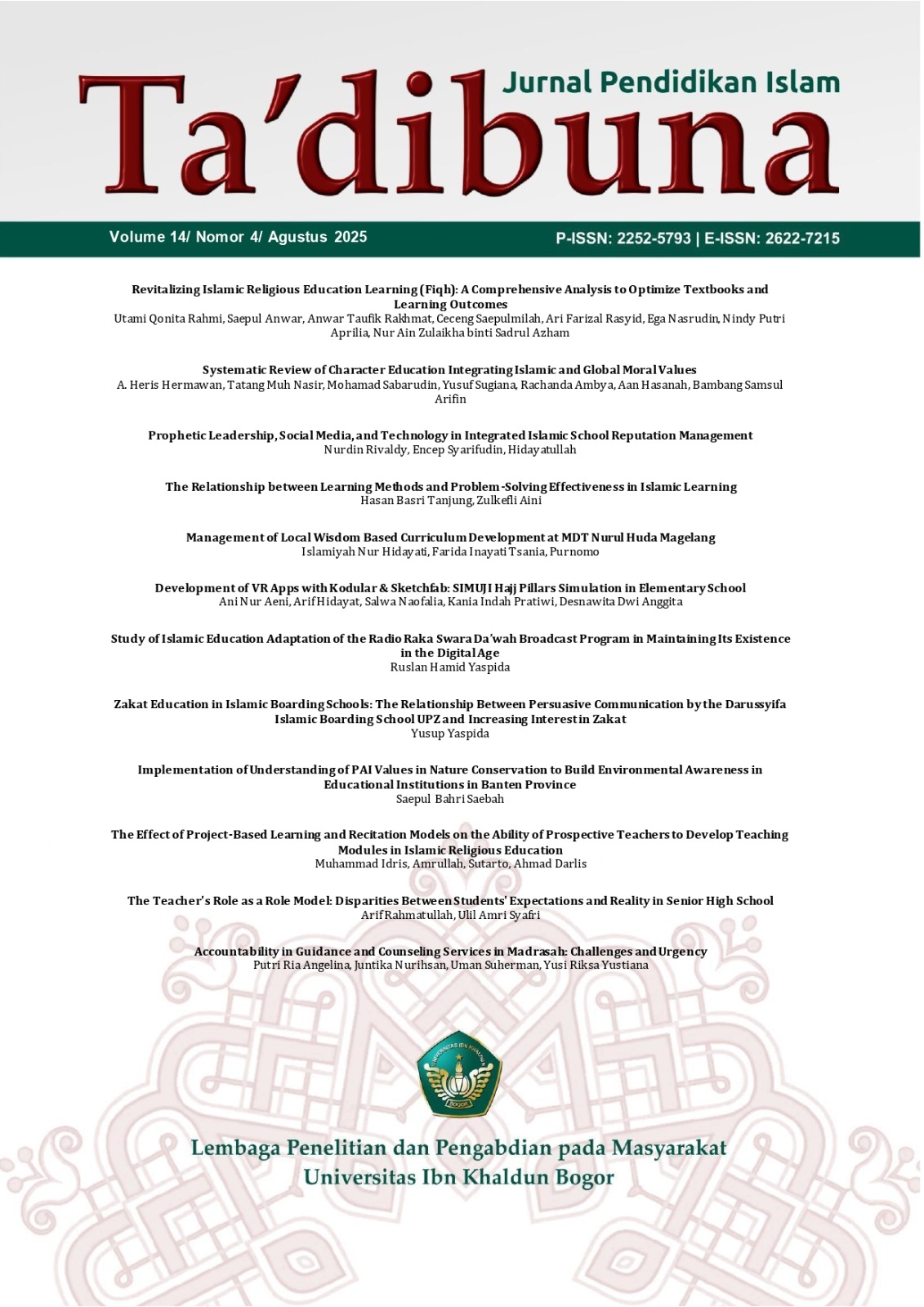
Study Of Islamic Education Adaptation Of The Radio Raka Swara Da'wah Broadcast Program In Maintaining Its Existence In The Digital Age
ADAPTASI PROGRAM SIARAN DAKWAH RADIO RAKA SWARA DALAM MEMPERTAHANKAN EKSISTENSINYA DI ERA DIGITAL
DOI:
https://doi.org/10.32832/tadibuna.v14i4.21337Keywords:
Program Adjustment; , Digital Da’wah;, Radio Raka Swara; , Media Innovation; , Digital TransformationAbstract
The development of the digital era has brought major changes in the way people access and consume media, which has had a significant impact on the sustainability of conventional media, including radio. Radio Raka Swara, as a local broadcasting station focusing on Islamic preaching content, has attempted to adapt to these dynamics in order to maintain its existence amid increasingly fierce competition from digital media. From the perspective of Islamic education studies, religious radio plays an important role as a means of non-formal education that can expand public access to Islamic knowledge and values. The purpose of this study is to identify and analyze the adaptation strategies employed by Radio Raka Swara in maintaining the sustainability of its religious programs while building audience trust. The research method used a descriptive qualitative approach through in-depth interviews, direct observation, and documentation study. The results show that Radio Raka Swara has successfully utilized various digital platforms such as YouTube, Instagram, TikTok, Spotify, and its own mobile application. The use of these platforms allows broadcasts to reach a wider audience, including international listeners, and to present da'wah content that is more visually appealing and interactive. Other strategies implemented include the use of traffic data for program evaluation, two-way interaction through live streaming features, and content adaptation to cross-generational characteristics. The implementation of these strategies is evident in the development of social media integration with radio broadcasts, training broadcasters to master digital broadcasting, and collaboration with online da'wah communities. Despite facing limitations in resources and promotional funds, Radio Raka Swara has proven that radio remains relevant if it transforms in line with technological developments and audience needs. Further research is recommended to examine the long-term impact of digitization on the da'wah consumption patterns of the younger generation, as well as to explore in greater depth sustainable business models that can truly support the financial independence of da'wah-based radio media in the modern digital era
References
Ali, H. M. (2024). Radio Three FM's strategy in adapting to the new media era (Doctoral dissertation, Uin Ar-Raniry Banda Aceh).
Anderson, T. (2021). Digital media and Islamic broadcasting: Challenges and strategies in content production. Journal of Media and Religion, 20(3), 210–225.
Dainga, H. (2025). Strategic management of media dakwah in the era of digital convergence. Jakarta: Al-Bayan Press.
Faiza, N. N., & Wardhani, I. S. (2024). 21st Century Learning Media: Building an Adaptive Digital Generation. Academic Media Journal (JMA), 2(12).
Ferbita, L. V., & Setianti, Y. (2020). Digital branding strategies of the Indonesian Institute of Sciences (LIPI) through social media. Journal of Communication Science Acta Diurna, 16(2).
Fernández-Sande, M., & Rodríguez-Pallares, M. (2022). Radio transformation in the digital age: New models of interactivity and content adaptation. Radio Journal: International Studies in Broadcast & Audio Media, 20(2), 112–130.
Firmansyah, D. (2025). Journalism in the convergence era unites television and social media. PT Rekacipta Proxy Media.
Harahap, A. F. R., & Harahap, A. M. (2023). The role of digitization in increasing public participation in state governance decision-making. Jurnal Educatio: Indonesian Education Journal, 9(2), 769-776.
Haryanti, U., & Saragih, M. Y. (2025). The presence of TV media journalism for millennials in the 4.0 era. Garut University Communication Journal: Thoughts and Research Results, 11(1), 311-327.
Hidayat, R. (2022). Changes in media consumption patterns in the digital era: A study of the millennial generation. Bandung: Remaja Rosda Karya.
Hidayat, R., & Nuri, S. (2024). Digital da'wah strategies among Generation Z: A study on the TikTok platform. Journal of Digital Islamic Communication, 5(1), 55–68.
Isnaeni, F., & Yucha, N. (2025). Digital branding strategies for tourist villages in Banyuwangi based on a participatory approach and local innovation. Semeru: Journal of Community Service, 188-196.
Jenkins, H. (2022). Participatory culture in a networked era: A conversation on youth, learning, commerce, and politics. Polity Press.
Maeskina, M. M., Hidayat, D., & Maharani, I. F. (2021). The IPPAR model of content creator approaches in maintaining reputation on snack video media. Communicatus: Journal of Communication Science, 5(2), 161-184.
McQuail, D. (2020). McQuail’s media and mass communication theory. London: Sage Publications.
Moleong, L. J. (2022). Qualitative research methodology. Bandung: PT Remaja Rosdakarya.
Nismara, R. S. (2024). Broadcasters' strategies in maintaining the existence of Swara Semarang radio in the digital era (Doctoral dissertation, Sultan Agung Islamic University Semarang).
Nugroho, C., Sos, S., & Kom, M. I. (2020). Cyber society: Technology, new media, and information disruption. Prenada Media.
Prasetya, A. E., Lutfiah, R. M., Nugroho, S., Zulfa, N. I., Idamatussilmi, V., Ismail, A. F., ... & Saputri, B. A. (2025). Public broadcasting in the digital era: Ethics, practice, and professionalism. Lutfi Gilang Publishers.
Radjaguguk, D. L., & Andriani, V. E. (2025). Graphic design as an effective communication medium in the digital era: Challenges and opportunities in the dynamics of digitalization. Digital Communication Transformation Towards a Sustainable Indonesia: Artificial Intelligence and Sustainable Digital Communication, 100.
Sitaniapessy, A. J., Letuna, M. A., & Sanga, A. P. (2024). Broadcast program management at radio stations: (Case study of the Kupang afternoon broadcast program on Radio Suara Kupang 96 FM). Deliberatio: Student Journal of Communication, 4(2), 338-353.
Sugiyono. (2024). Qualitative, quantitative, and R&D research methods. Bandung: Alfabeta.
Syamaidzar, M. D. (2025). Optimizing digital accessibility on the Radio Suara Kota Probolinggo website using the rapid application development model (Doctoral dissertation, Maulana Malik Ibrahim State Islamic University).
Tugu, P. A. R., Rantelobo, K., & Andung, P. A. (2025). The effect of innovation disruption on radio listener loyalty. Journal of Communication Ethnography, 4(1), 21-39.
Vernanda, R. D. (2021). Sunan Bonang's dakwah media through Javanese Gending (Doctoral dissertation, UIN Raden Intan Lampung).
Zafar, A., & Aleem, A. (2022). Enhancing Islamic communication through social media aesthetics. International Journal of Islamic Communication Studies, 3(2), 135–147.
Downloads
Published
How to Cite
Issue
Section
License
Copyright (c) 2025 Ta'dibuna: Jurnal Pendidikan Islam

This work is licensed under a Creative Commons Attribution-ShareAlike 4.0 International License.
Penulis memberikan hak cipta karyanya kepada jurnal yang dilisensikan dengan CC-BY-SA or The Creative Commons Attribution–ShareAlike License yang memungkinkan orang lain untuk menggunakan karya dengan pengakuan kepengarangan karya dan publikasi awal dalam jurnal ini.