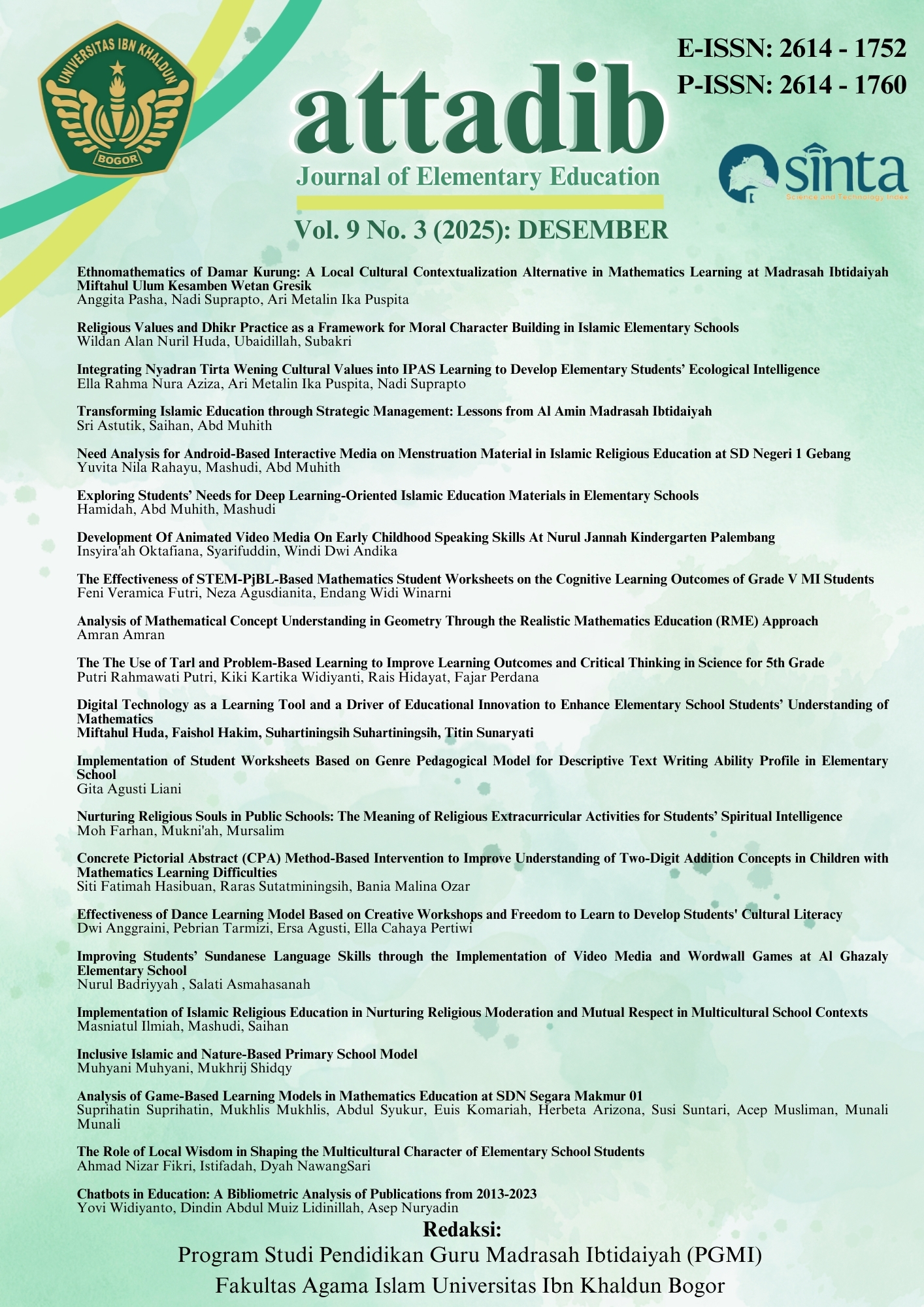
Concrete Pictorial Abstract (CPA) Method-Based Intervention to Improve Understanding of Two-Digit Addition Concepts in Children with Mathematics Learning Difficulties
DOI:
https://doi.org/10.32832/at-tadib.v9i3.22314Keywords:
Concrete Pictorial Abstract, Mathematics Learning Difficulties, Mathematics AnxietyAbstract
Mathematics learning difficulties in elementary school children remain a critical issue due to their impact on cognitive development, academic readiness, and emotional regulation. This study emphasizes the importance of instructional approaches that align with children’s cognitive developmental stages, particularly for those who have not yet fully reached concrete operational thinking despite having adequate intellectual potential. This study aimed to describe the cognitive and affective profile of a child with mathematics learning difficulties and to analyze changes in conceptual understanding following the implementation of the Concrete–Pictorial–Abstract (CPA) approach in two-digit arithmetic. A qualitative case study design was employed, involving psychological assessment, observation of learning behavior, cognitive testing, error analysis, and a four-stage CPA intervention. Data were analyzed thematically to identify patterns of difficulty, thinking processes, and learning changes before and after the intervention. The findings showed an increase in calculation accuracy from 41.6% to 83%, accompanied by reduced mathematics anxiety, increased learning engagement, and the emergence of basic mental calculation strategies. Follow-up results indicated an 80% retention of skills, suggesting that the conceptual understanding developed through the CPA stages was relatively stable. Overall, this study highlights the role of a developmentally appropriate, concrete visual abstract learning sequence in supporting both cognitive and affective aspects of mathematics learning in children with specific learning difficulties. Further research is recommended to explore the application of this approach in broader educational contexts.
References
Ashcraft, M. H., & Moore, A. M. (2009). Mathematics Anxiety and the Affective Drop in Performance. Journal of Psychoeducational Assessment, 27(3), 197–205. https://doi.org/10.1177/0734282908330580
Barbieri, C. A., Rodrigues, J., Dyson, N., & Jordan, N. C. (2020). Improving fraction understanding in sixth graders with mathematics difficulties: Effects of a number line approach combined with cognitive learning strategies. Journal of Educational Psychology, 112(3), 628–648. https://doi.org/10.1037/edu0000384
Bruner, J. S. (1966). Toward a Theory of Instruction (Vol. 59). Harvard University Press.
Chen, W. (2024). Problem-Solving Skills, Memory Power, and Early Childhood Mathematics: Understanding the Significance of the Early Childhood Mathematics in an Individual’s Life. Journal of the Knowledge Economy, 16(1), 1–25. https://doi.org/10.1007/s13132-023-01557-6
Grigorenko, E. L., Compton, D. L., Fuchs, L. S., Wagner, R. K., Willcutt, E. G., & Fletcher, J. M. (2020). Understanding, educating, and supporting children with specific learning disabilities: 50 years of science and practice. American Psychologist, 75(1), 37–51. https://doi.org/10.1037/amp0000452
Hasibuan, A. T., & Prastowo, A. (2019). Konsep Pendidikan Abad 21: Kepemimpinan dan Pengembangan Sumber Daya Manusia Sd/Mi. MAGISTRA: Media Pengembangan Ilmu Pendidikan Dasar Dan Keislaman, 10(1). https://doi.org/10.31942/mgs.v10i1.2714
Hasibuan, A. T., Sianipar, M. R., Ramdhani, A. D., Putri, F. W., & Ritonga, N. Z. (2022). Konsep dan Karakteristik Penelitian Kualitatif Serta Perbedaannya Dengan Penelitian Kuantitatif. Jurnal Pendidikan Tambusai, 6(2), 8686–8692.
Hasibuan, A. T., Simatupang, W. W., Rudini, R., & Ani, S. (2023). Implementasi Sistem Pendidikan Terbaik Dunia di Jenjang Anak Usia Dasar Telaah Sistem Pendidikan Finlandia. JURNAL PEMBELAJARAN DAN MATEMATIKA SIGMA (JPMS), 9(1). https://doi.org/10.36987/jpms.v9i1.4383
Holmes, J., Guy, J., Kievit, R. A., Bryant, A., Mareva, S., & Gathercole, S. E. (2021). Cognitive dimensions of learning in children with problems in attention, learning, and memory. Journal of Educational Psychology, 113(7), 1454–1480. https://doi.org/10.1037/edu0000644
Kroesbergen, E. H., Huijsmans, M. D. E., & Friso-van den Bos, I. (2023). A Meta-Analysis on the Differences in Mathematical and Cognitive Skills Between Individuals With and Without Mathematical Learning Disabilities. Review of Educational Research, 93(5), 718–755. https://doi.org/10.3102/00346543221132773
Leeming, D., Marshall, J., & Hinsliff, S. (2022). Self-conscious emotions and breastfeeding support: A focused synthesis of UK qualitative research. Maternal & Child Nutrition, 18(1). https://doi.org/10.1111/mcn.13270
Lein, A. E., Jitendra, A. K., & Harwell, M. R. (2020). Effectiveness of mathematical word problem solving interventions for students with learning disabilities and/or mathematics difficulties: A meta-analysis. Journal of Educational Psychology, 112(7), 1388–1408. https://doi.org/10.1037/edu0000453
Marinda, L. (2020). Teori Perkembangan Kognitif Jean Piaget Dan Problematikanya Pada Anak Usia Sekolah Dasar. An-Nisa Jurnal Kajian Perempuan Dan Keislaman, 13(1), 116–152. https://doi.org/10.35719/annisa.v13i1.26
Santrock, J. W. (2011). Life-Span Development. McGraw Hill.
Tharinger, D. J., Rudin, D. I., Frackowiak, M., & Finn, S. E. (2022). Therapeutic Assessment with Children: Enhancing Parental Empathy Through Psychological Assessment (1 ed.). Routledge. https://doi.org/10.4324/9781003000174
Zhou, D., Du, X., Hau, K.-T., Luo, H., Feng, P., & Liu, J. (2020). Teacher-student relationship and mathematical problem-solving ability: Mediating roles of self-efficacy and mathematical anxiety. Educational Psychology, 40(4), 473–489. https://doi.org/10.1080/01443410.2019.1696947