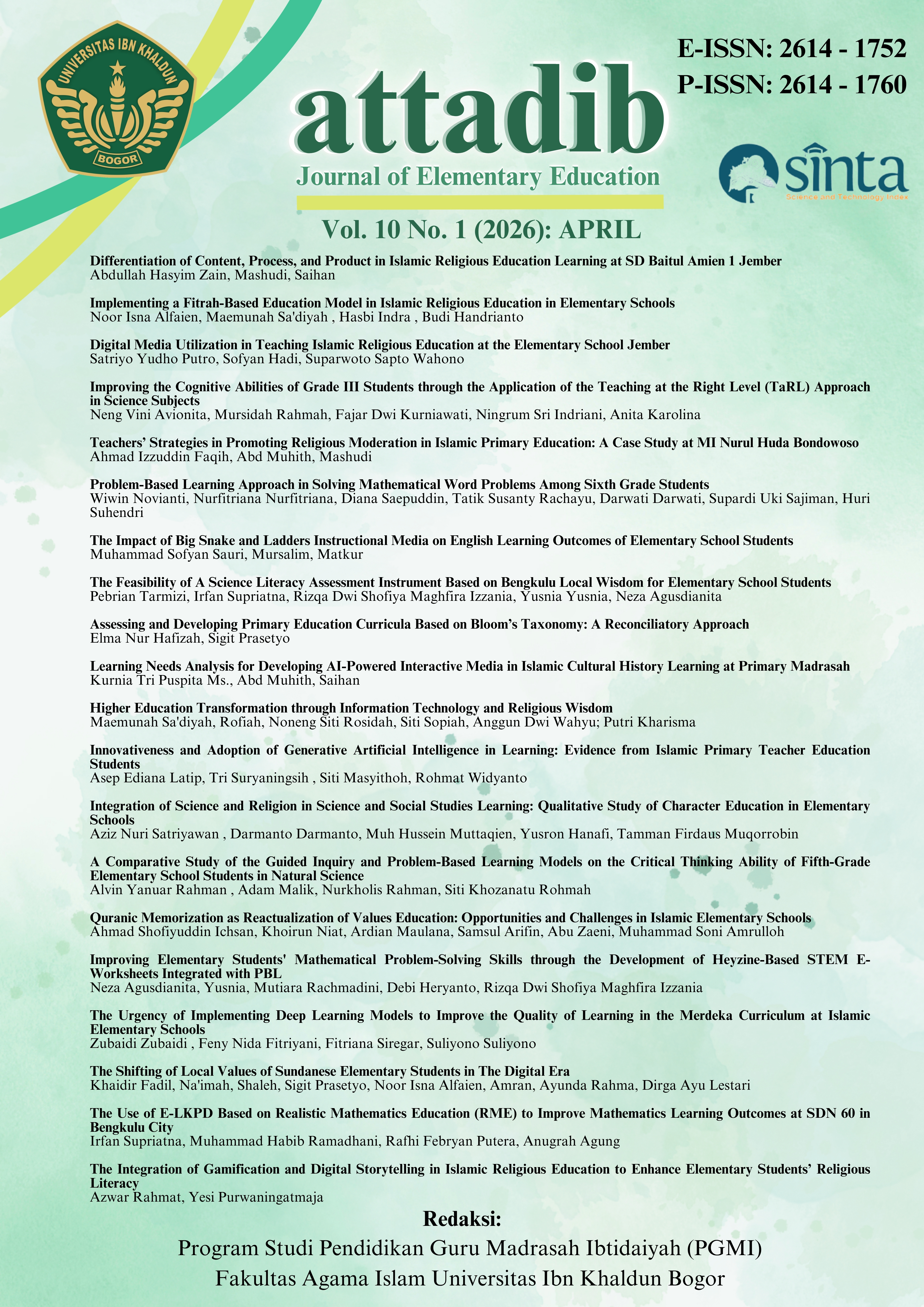
Innovativeness and Adoption of Generative Artificial Intelligence in Learning: Evidence from Islamic Primary Teacher Education Students
DOI:
https://doi.org/10.32832/at-tadib.v10i1.23201Keywords:
Generative Artificial Intelligence, Student Innovativeness, Technology Adoption, Diffusion of InnovationAbstract
The integration of digital technology, particularly Generative Artificial Intelligence (AI), has become a crucial demand in contemporary teacher education. However, the extent to which student innovativeness influences AI adoption in learning remains underexplored, especially among Islamic Primary Teacher Education (PGMI) students. This study aims to examine the level of student innovativeness and its effect on the adoption of Generative AI in learning. This research employed a quantitative survey design involving 120 undergraduate PGMI students selected through purposive sampling, specifically those who had prior experience using Generative AI tools. Data were collected using a validated questionnaire consisting of 18 items, covering student innovativeness (8 items) and AI adoption (10 items), measured on a 5-point Likert scale. The instrument demonstrated strong validity (r-count > r-table = 0.179) and high reliability (Cronbach’s Alpha: 0.89 for innovativeness and 0.93 for AI adoption). Data were analyzed using descriptive statistics, Pearson correlation, and simple linear regression. The results show that student innovativeness (M = 3.82; SD = 0.56) and AI adoption (M = 3.75; SD = 0.61) are both categorized as high. A significant positive correlation was found between innovativeness and AI adoption (r = 0.621, p < 0.001). Furthermore, regression analysis indicates that student innovativeness significantly predicts AI adoption (β = 0.655, t = 9.876, p < 0.001), explaining 38.6% of the variance (R² = 0.386). These findings suggest that more innovative students are more likely to adopt and utilize Generative AI effectively in learning activities. Despite these positive findings, challenges such as limited digital literacy, ethical concerns, and lack of pedagogical guidance remain evident. This study highlights the importance of fostering student innovativeness alongside structured institutional support, including digital literacy training and ethical frameworks, to optimize the integration of Generative AI in teacher education.
References
Agarwal, R., & Prasad, J. (1998). A conceptual and operational definition of personal innovativeness in the domain of information technology. Information Systems Research, 9(2), 204–215. https://doi.org/10.1287/isre.9.2.204
Davis, F. D. (1989). Perceived usefulness, perceived ease of use, and user acceptance of information technology. MIS Quarterly, 13(3), 319–340. https://doi.org/10.2307/249008
Dwivedi, Y. K., Kshetri, N., Hughes, L., Slade, E. L., Jeyaraj, A., Kar, A. K., Baabdullah, A. M., Koohang, A., Raghavan, V., Ahuja, M., Albanna, H., Albashrawi, M., Al-Busaidi, K. A., Balakrishnan, J., Barlette, Y., Basu, S., Bose, I., Brooks, L., Buhalis, D., … Wright, R. (2023). So what if ChatGPT wrote it? Multidisciplinary perspectives on opportunities, challenges and implications of generative conversational AI for research, practice and policy. International Journal of Information Management, 71, 102642. https://doi.org/10.1016/j.ijinfomgt.2023.102642
Holmes, W., Bialik, M., & Fadel, C. (2022). Artificial intelligence in education: Promises and implications for teaching and learning. Center for Curriculum Redesign.
Huda, M., Hakim, F., Suhartiningsih, & Sunaryati, T. (2025). Attadib: Journal of Elementary Education Digital Technology as a Learning Tool and a Driver of Educational Innovation to Enhance Elementary School Students’ Understanding of Mathematics. Attadib: Journal of Elementary Education, 9(3), 718–731
Kasneci, E., Sessler, K., Küchemann, S., Bannert, M., Dementieva, D., Fischer, F., Gasser, U., Groh, G., Günnemann, S., Hüllermeier, E., Krusche, S., Kutyniok, G., Michaeli, T., Nerdinger, F. W., Pfeffer, J., Poquet, O., Sailer, M., Schmidt, A., Seidel, T., … Kasneci, G. (2023). ChatGPT for good? On opportunities and challenges of large language models for education. Learning and Individual Differences, 103, 102274. https://doi.org/10.1016/j.lindif.2023.102274
Rogers, E. M. (2003). Diffusion of innovations (5th ed.). Free Press.
Scherer, R., Siddiq, F., & Tondeur, J. (2019). The technology acceptance model (TAM): A meta-analytic structural equation modeling approach. Computers & Education, 128, 13–35. https://doi.org/10.1016/j.compedu.2018.09.009
Teo, T. (2011). Factors influencing teachers’ intention to use technology: Model development and test. Computers & Education, 57(4), 2432–2440. https://doi.org/10.1016/j.compedu.2011.06.008
UNESCO. (2021). AI and education: Guidance for policy-makers. UNESCO Publishing.
Venkatesh, V., Morris, M. G., Davis, G. B., & Davis, F. D. (2003). User acceptance of information technology: Toward a unified view. MIS Quarterly, 27(3), 425–478. https://doi.org/10.2307/30036540
Yi, M. Y., Jackson, J. D., Park, J. S., & Probst, J. C. (2006). Understanding information technology acceptance by individual professionals: Toward an integrative view. Information & Management, 43(3), 350–363. https://doi.org/10.1016/j.im.2005.08.006
Zawacki-Richter, O., Marín, V. I., Bond, M., & Gouverneur, F. (2019). Systematic review of research on artificial intelligence applications in higher education. International Journal of Educational Technology in Higher Education, 16(1), 39. https://doi.org/10.1186/s41239-019-0171-0