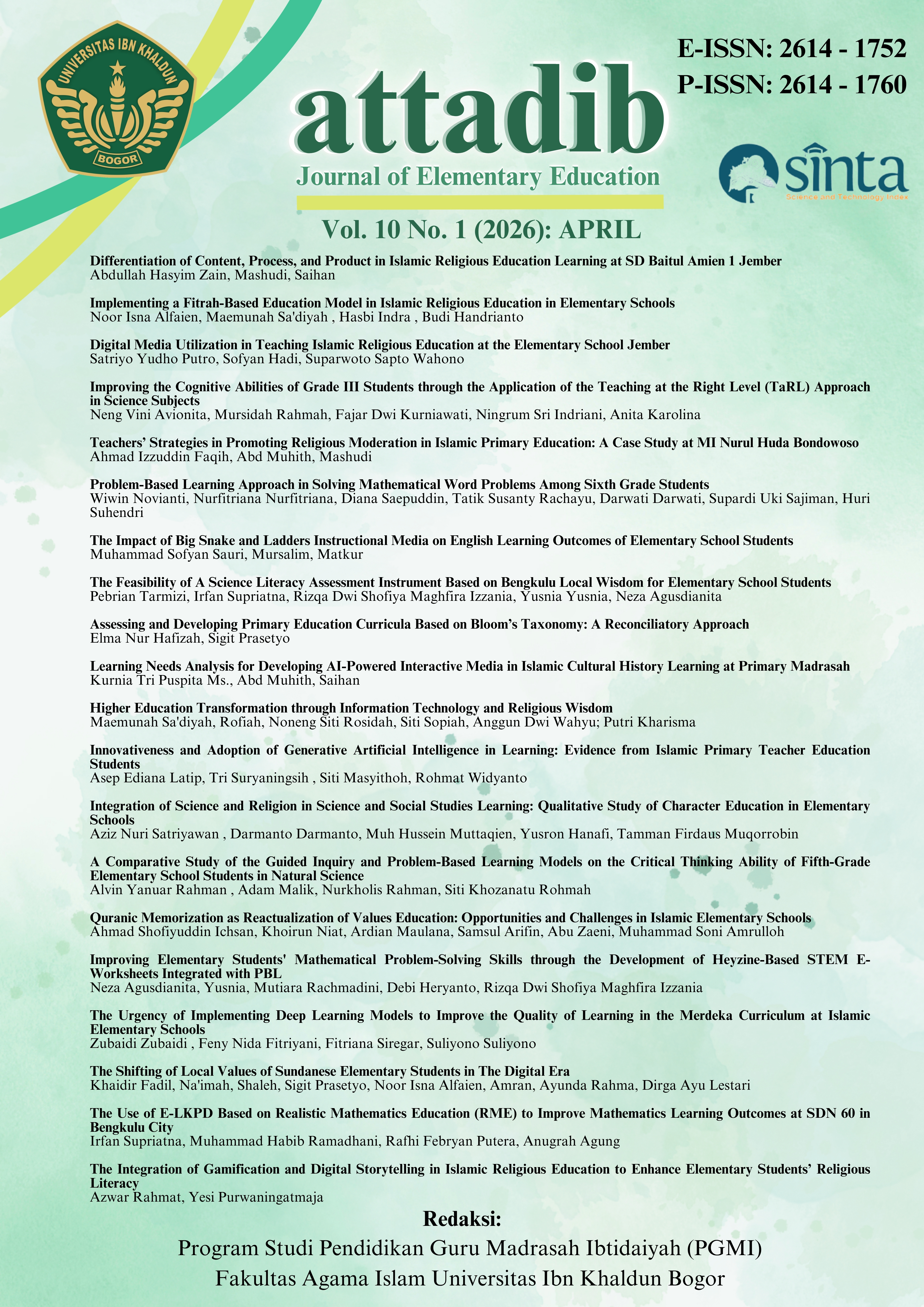
The Urgency of Implementing Deep Learning Models to Improve the Quality of Learning in the Merdeka Curriculum at Islamic Elementary Schools
DOI:
https://doi.org/10.32832/at-tadib.v10i1.23221Kata Kunci:
Deep Learning Literacy, Teaching Quality, Independent Curriculum, Islamic Elementary SchoolsAbstrak
This study examines the urgency of implementing deep learning models to improve the quality of learning within the framework of the Merdeka Curriculum in Islamic Elementary Schools. The study employed a multi-site case study design with a qualitative approach conducted at three Islamic Elementary Schools in Cipondoh District, Tangerang City. The participants consisted of 25 informants, including teachers, principals, students, parents, and community representatives. Data were collected through in-depth interviews, classroom observations, and document analysis, and were analyzed using thematic and cross-case analysis to identify similarities and differences in implementation across research sites. The findings reveal that the implementation of deep learning is considered important in supporting adaptive, differentiated, and student-centered learning in line with the principles of the Merdeka Curriculum. Teachers perceived that this approach could enhance student engagement, critical thinking skills, collaboration, and the quality of formative assessment. However, its implementation still faces several challenges, including limited infrastructure, inadequate digital and pedagogical competence among teachers, limited access to professional development, and uneven institutional readiness. In addition, structural challenges related to curriculum alignment, madrasah administrative systems, and the integration of Islamic educational values also influence the effectiveness of deep learning implementation. This study concludes that deep learning should not only be understood as a pedagogical innovation, but also as a systemic transformation that requires policy support, teacher capacity building, institutional readiness, and the development of a contextual, ethical, and sustainable learning ecosystem within Islamic Elementary Schools. The findings provide both theoretical and practical contributions to the development of technology-based learning and the transformation of Islamic education in the era of the Merdeka Curriculum.
Referensi
Abedi, E. A. (2024). Tensions between technology integration practices of teachers and ICT in education policy expectations: implications for change in teacher knowledge, beliefs and teaching practices. Journal of computers in education, 11(4), 1215-1234. https://doi.org/10.1007/s40692-023-00296-6
Ahmad, K., Iqbal, W., El-Hassan, A., Qadir, J., Benhaddou, D., Ayyash, M., & Al-Fuqaha, A. (2023). Data-driven artificial intelligence in education: A comprehensive review. IEEE Transactions on Learning Technologies, 17, 12-31. https://doi.org/10.1109/TLT.2023.3314610
Ahmad, Z. A., Rohman, A. T. H., & Rini, D. K. (2025). The role of artificial intelligence in enhancing pedagogical methods in modern Islamic education. Journal of Hunan University Natural Sciences, 52(6). 101-112. https://doi.org/10.55463/issn.1674-2974.52.6.9
Alfoudari, A. M., Durugbo, C. M., & Aldhmour, F. M. (2023). Exploring quality attributes of smart classrooms from the perspectives of academics. Education and Information Technologies, 28(10), 13109-13151. https://doi.org/10.1007/s10639-022-11452-3
Almusawi, H. A., & Durugbo, C. M. (2024). Linking task-technology fit, innovativeness, and teacher readiness using structural equation modelling. Education and Information Technologies, 29(12),14899-14928. https://doi.org/10.1080/03054985.2025.2539397
Andriyati, N., Amin, A., & Li, Y. (2025). Voices from the classroom: perceptions and obstacles in Indonesian curriculum reform. Oxford Review of Education, 1-20. https://doi.org/10.1080/03054985.2025.2539397
Arnaud, J., São Mamede, H., & Branco, F. (2025). The relationship between digital transformation and digital literacy-an explanatory model: Systematic literature review. F1000Research, 13, 253. https://doi.org/10.12688/f1000research.146991.2
Bakar, M. Y. A., Firmansyah, E., & Abdeljelil, M. B. (2024). Legal Framework Analysis of Islamic Religious Education Policy Implementation. International Journal of Law and Society (IJLS), 3(3), 217-237. https://doi.org/10.59683/ijls.v3i3.143
Bang, H. J., Li, L., & Flynn, K. (2023). Efficacy of an adaptive game-based math learning app to support personalized learning and improve early elementary school students’ learning. Early Childhood Education Journal, 51(4), 717-732. https://doi.org/10.1007/s10643-022-01332-3
Bareis, J., & Katzenbach, C. (2022). Talking AI into being: The narratives and imaginaries of national AI strategies and their performative politics. Science, Technology, & Human Values, 47(5), 855-881. https://doi.org/10.1177/01622439211030007
Bhardwaj, V., Zhang, S., Tan, Y. Q., & Pandey, V. (2025, February). Redefining learning: student-centered strategies for academic and personal growth. In Frontiers in Education (Vol. 10, p. 1518602). Frontiers Media SA. https://doi.org/10.3389/feduc.2025.1518602
Bond, M., Zawacki-Richter, O., & Nichols, M. (2021). Revisiting five decades of educational technology research. Educational Technology Research and Development, 69(1), 1–29. https://doi.org/10.1111/bjet.12730
Bressane, A., Zwirn, D., Essiptchouk, A., Saraiva, A. C. V., de Campos Carvalho, F. L., Formiga, J. K. S., ... & Negri, R. G. (2024). Understanding the role of study strategies and learning disabilities on student academic performance to enhance educational approaches: A proposal using artificial intelligence. Computers and Education: Artificial Intelligence, 6(100196). 1-13. https://doi.org/10.1016/j.caeai.2023.100196
Buhmann, A., & Fieseler, C. (2023). Deep learning meets deep democracy: Deliberative governance and responsible innovation in artificial intelligence. Business Ethics Quarterly, 33(1), 146-179. https://doi.org/10.1017/beq.2021.42
Chang, D. H., Lin, M. P. C., Hajian, S., & Wang, Q. Q. (2023). Educational design principles of using AI chatbot that supports self-regulated learning in education: Goal setting, feedback, and personalization. Sustainability, 15(17), 12921. https://doi.org/10.3390/su151712921
Chen, L., Chen, P., & Lin, Z. (2020). Artificial intelligence in education: A review. IEEE Access, 8, 75264–75278. https://doi.org/10.1109/ACCESS.2020.2988510
Creswell, John W., & Poth, Cheryl N. (2021). Qualitative inquiry and research design: Choosing among five approaches (4th ed.). SAGE Publications.
Darling-Hammond, L., Flook, L., Cook-Harvey, C., Barron, B., & Osher, D. (2020). Implications for educational practice of the science of learning and development. Applied Developmental Science, 24(2), 97–140. https://doi.org/10.1080/10888691.2018.1537791
Darling-Hammond, L., Flook, L., Cook-Harvey, C., Barron, B., & Osher, D. (2020). Implications for educational practice of the science of learning and development. Applied Developmental Science, 24(2), 97–140. https://doi.org/10.1080/10888691.2018.1537791
Ding, A. C. E., Shi, L., Yang, H., & Choi, I. (2024). Enhancing teacher AI literacy and integration through different types of cases in teacher professional development. Computers and Education open, 6, 100178. https://doi.org/10.1016/j.caeo.2024.100178
Fitrah, M., Sofroniou, A., Yarmanetti, N., Ismail, I. H., Anggraini, H., Nissa, I. C., ... & Setiawan, D. (2025). Are teachers ready to adopt deep learning pedagogy? The role of technology and 21st-century competencies amid educational policy reform. Education sciences, 15(10), 1344. https://doi.org/10.3390/educsci15101344
Hakim, M. N., Solihah, K. Z., Ismail, F., Salim, A., & Prasetiyo, N. T. (2024). Optimizing the Merdeka Curriculum for Developing the Pancasila Student Profile through Project-Based Learning. Munaddhomah: Jurnal Manajemen Pendidikan Islam, 5(4), 395-408. https://doi.org/10.31538/munaddhomah.v5i4.1396
Hälterlein, J. (2025). Imagining and governing artificial intelligence: the ordoliberal way-an analysis of the national strategy ‘AI made in Germany’. AI & SOCIETY, 40(3), 1749-1760. https://doi.org/10.1007/s00146-024-01940-0
Hidayat, R. (2025). A Systematic Literature Review of Prior Studies on the Indonesian Independent Campus Policy (2020–2023). In Higher Education Forum, 22, 69-97. https://doi.org/10.15027/0002040521
Holmes, W., Bialik, M., & Fadel, C. (2022). Artificial Intelligence in Education: Promise and Implications for Teaching and Learning. Center for Curriculum Redesign. https://vicasaorg/wp-content/uploads/2024/05/ArtificialIntelligenceinEducation.PromiseandImplicationsforTeachingandLearning.pdf
Jailani, M., Prahmana, R. C. I., & Widodo, H. (2025). A narrative review of child-friendly school implementation in religious-based education: a transformative perspective from Indonesia, Asia, and the global context. International Journal of Child Care and Education Policy, 19(1), 1-29. https://doi.org/10.1186/s40723-025-00165-y
Khondoker, S. U. A., Waston, An, A. N., Mahmudulhassan, & Muthoifin. (2025). The Role of Faith-Based Education in Bangladesh’s Multicultural System and Its Impact on the Sustainable Development Goals (SDGs). Journal of Lifestyle and SDGs Review, 5(2), e03472-e03472. https://doi.org/10.47172/2965-730X.SDGsReview.v5.n02.pe03472
Kusumawati, E., Suswandari, & Umam, K. (2025). Strengthening teacher competence for leading and sustaining the implementation of the Merdeka Curriculum. Cogent Education, 12(1), 2501458. https://doi.org/10.1080/2331186X.2025.2501458
Ma, T., Li, Y., Yuan, H., Li, F., Yang, S., Zhan, Y., ... & Mu, D. (2023). Reflection on the teaching of student-centred formative assessment in medical curricula: an investigation from the perspective of medical students. BMC Medical Education, 23(1), 141. https://doi.org/10.1186/s12909-023-04110-w
McCulloch, G. (2021). Ethical guidelines for educational research (4th ed.). British Educational Research Association. https://www.bera.ac.uk/publication/ethical-guidelines-for-educational-research-2018
Meng, Q., Yan, Z., Abbas, J., Shankar, A., & Subramanian, M. (2025). Human–computer interaction and digital literacy promote educational learning in pre-school children: mediating role of psychological resilience for kids’ mental well-being and school readiness. International Journal of Human–Computer Interaction, 41(1), 16-30. https://doi.org/10.1080/10447318.2023.2248432
Mhlanga, D., & Ndhlovu, E. (2023). Digital technology adoption in the agriculture sector: Challenges and complexities in Africa. Human Behavior and Emerging Technologies, 2023(1), 6951879. https://doi.org/10.1155/2023/6951879
Molenaar, I. (2022). Towards hybrid human‐AI learning technologies. European Journal of Education, 57(4), 632-645. https://doi.org/10.1111/ejed.12527
Moltudal, S. H., Krumsvik, R. J., & Høydal, K. L. (2022). Adaptive learning technology in primary education: Implications for professional teacher knowledge and classroom management. In Frontiers in Education (Vol. 7, p. 830536). Frontiers Media SA. https://doi.org/10.3389/feduc.2022.830536
Muslim, M. (2024). Internalizing Digital Technology in Islamic Education. Scaffolding: Jurnal Pendidikan Islam dan Multikulturalisme, 6(3), 180-197. https://doi.org/10.37680/scaffolding.v6i3.6309
Ng, D. T. K., Leung, J. K. L., Su, J., Ng, R. C. W., & Chu, S. K. W. (2023). Teachers’ AI digital competencies and twenty-first century skills in the post-pandemic world. Educational technology research and development, 71(1), 137-161. https://doi.org/10.1007/s11423-023-10203-6
Nurhayati, S., Taufikin, T., Judijanto, L., & Musa, S. (2025). Towards Effective Artificial Intelligence-Driven Learning in Indonesian Child Education: Understanding Parental Readiness, Challenges, and Policy Implications. Educational Process. International Journal, 15, 1-29. https://doi.org/10.22521/edupij.2025.15.155
OECD. (2019). Education in Indonesia: Rising to the Challenge. OECD Publishing.
OECD. (2021). Digital education outlook 2021: Pushing the frontiers with AI, blockchain and robots. OECD Publishing. https://doi.org/10.1787/589b283f-en
Owan, V. J., Abang, K. B., Idika, D. O., Etta, E. O., & Bassey, B. A. (2023). Exploring the potential of artificial intelligence tools in educational measurement and assessment. Eurasia journal of mathematics, science and technology education, 19(8), em2307. https://doi.org/10.29333/ejmste/13428
Papakostas, C. (2025). Artificial Intelligence in Religious Education: Ethical, Pedagogical, and Theological Perspectives. Religions, 16(5), 563. https://doi.org/10.3390/rel16050563
Parasti, N., & Murwaningsih, T. (2025). Elementary School Teachers' Understanding of Differentiated Instruction: Challenges and Opportunities. PrimaryEdu: Journal of Primary Education, 9(2), 42-57. https://doi.org/10.22460/pej.v9i2.6015
Rahimi, R. A., & Oh, G. S. (2025). Beyond theory: a systematic review of strengths and limitations in technology acceptance models through an entrepreneurial lens. Journal of Marketing Analytics, 13(4), 1195-1218. https://doi.org/10.1057/s41270-024-00318-x
Ridder, H. G., Hoon, C., & McCandless Baluch, A. (2021). Entering a dialogue: Positioning case study findings towards theory. British Journal of Management, 32(2), 538–552. https://doi.org/10.1111/1467-8551.12455
Robles, P., & Mallinson, D. J. (2025). Artificial intelligence technology, public trust, and effective governance. Review of Policy Research, 42(1), 11-28. https://doi.org/10.1111/ropr.12555
Rohman, R. L., Susantini, E., Raharjo, R., Makhtar, M. M. Z., & Satriawan, M. (2025). The effectiveness of probing prompting models for critical thinking development in indonesian science education: A systematic literature review. Jurnal Pendidikan MIPA, 26(3), 1428-1444. https://doi.org/10.23960/jpmipa.v26i3.pp1428-1444
Saar, M., Rodríguez-Triana, M. J., & Santos, L. P. P. (2022). Towards data-informed teaching practice: A model for integrating analytics with teacher inquiry. Journal of Learning Analytics, 9(3), 88-103. https://doi.org/10.18608/jla.2022.7505
Sajja, R., Sermet, Y., Cwiertny, D., & Demir, I. (2025). Integrating AI and learning analytics for data-driven pedagogical decisions and personalized interventions in education. Technology, knowledge and learning, 1-31. https://doi.org/10.1007/s10758-025-09897-9
Singun, A. J. (2025). Unveiling the barriers to digital transformation in higher education institutions: a systematic literature review. Discover Education, 4(1), 37. https://doi.org/10.21203/rs.3.rs-4970233/v1
Tabaghdehi, S. A. H., & Ayaz, Ö. (2025). AI ethics in action: a circular model for transparency, accountability and inclusivity. Journal of Managerial Psychology. Vol. ahead-of-print No. ahead-of-print. https://doi.org/10.1108/JMP-03-2024-0177
Tatar, C., Jiang, S., Rosé, C. P., & Chao, J. (2025). Exploring teachers’ views and confidence in the integration of an artificial intelligence curriculum into their classrooms: a case study of curricular co-design program. International Journal of Artificial Intelligence in Education, 35(2), 702-735. https://doi.org/10.1007/s40593-024-00404-2
Thompson, B. S., & Rust, S. (2023). Blocking blockchain: Examining the social, cultural, and institutional factors causing innovation resistance to digital technology in seafood supply chains. Technology in Society, 73, 102235. https://doi.org/10.1016/j.techsoc.2023.102235
Turós, M., Tari, I. P., Szőke-Milinte, E., Rubovszky, R., Soltész-Várhelyi, K., Zsódi, V., & Szűts, Z. (2025). Beyond Utility: The Impact of Religiosity and Calling on AI Adoption in Education. Religions, 16(8), 1069. https://doi.org/10.3390/rel16081069
Wong, J. M. S., & Li, K. C. (2025). Technology-Enabled Institutional Readiness for Agile-Blended Learning: A Framework for Educational Innovation. SN Computer Science, 6(3), 279. https://doi.org/10.1007/s42979-025-03902-9
World Bank. (2020). The Promise of Education in Indonesia. World Bank Publications.
Xue, L., Mahat, J., & Ghazali, N. (2026). Technology Acceptance Model in Artificial Intelligence in Education: A Meta-Analysis. Sage Open, 16(1). 1-23. https://doi.org/10.1177/21582440251409441
Yin, R. K. (2018). Case study research and applications (Vol. 6). Thousand Oaks, CA: Sage Publication, Inc. https://uk.sagepub.com/en-gb/asi/case-study-research-and-applications/book250150
Zagkotas, V. (2025). Artificial Intelligence and the Didactic Transposition of Knowledge: Implications for Curriculum Development and Knowledge Gatekeeping. Futurity Education, 5(2), 44–66. https://doi.org/10.57125/FED.2025.06.25.03
Zawacki-Richter, O., Marín, V. I., Bond, M., & Gouverneur, F. (2019). Systematic review of research on artificial intelligence applications in higher education. International Journal of Educational Technology in Higher Education, 16(1), 39. https://doi.org/10.1186/s41239-019-0171-0
Zhang, J., & Zhang, Z. (2024). AI in teacher education: Unlocking new dimensions in teaching support, inclusive learning, and digital literacy. Journal of Computer Assisted Learning, 40(4), 1871-1885. https://doi.org/10.1111/jcal.12988
Zheng, Y., & Li, D. (2025). Learning analytics-informed teaching strategies: enhancing interactive learning in STEM education. Interactive Learning Environments, 1-30. https://doi.org/10.1080/10494820.2025.2553113