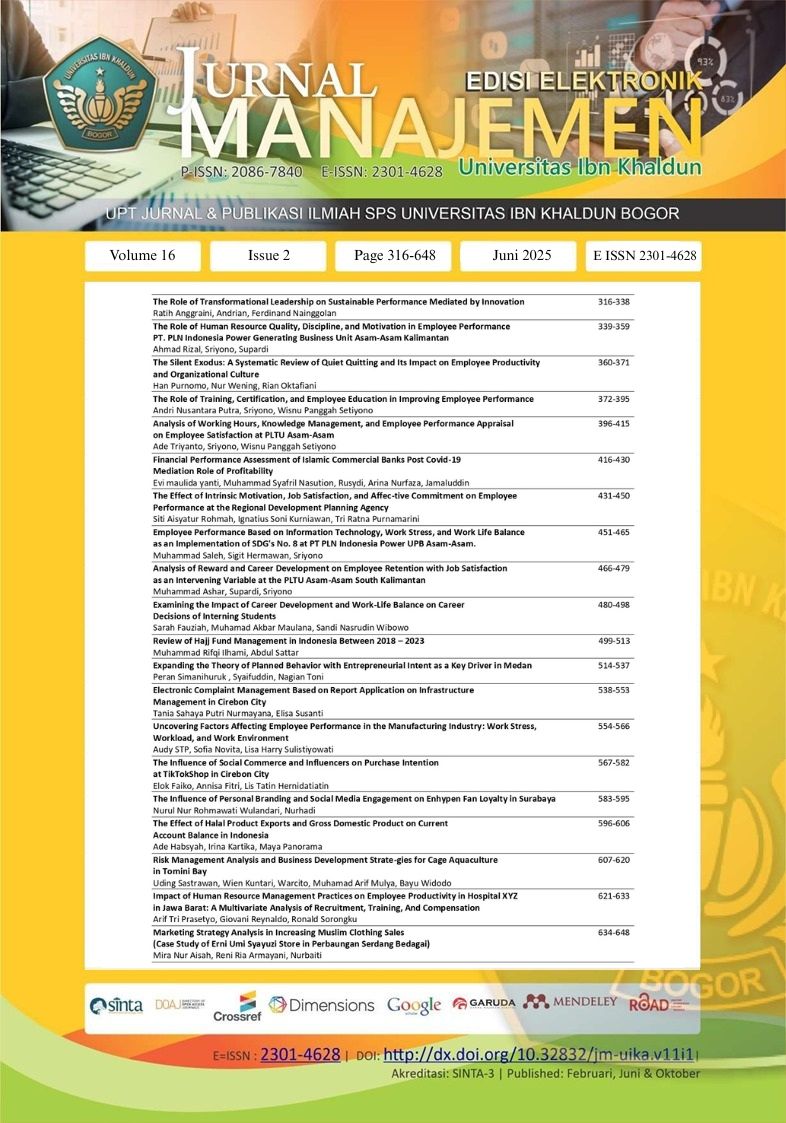
The Effect of Intrinsic Motivation, Job Satisfaction, and Affec-tive Commitment on Employee Performance at the Regional Development Planning Agency
DOI:
https://doi.org/10.32832/jm-uika.v16i2.19100Keywords:
intrinsic motivation, job satisfaction, affective commitment, employee performanceAbstract
The purpose of this study was to examine the influence of intrinsic motivation, job satisfaction, and affective commitment on employee performance at the Regional Development Planning Agency of Yogyakarta City, DI Yogyakarta. A total of 95 people provided primary data through direct surveys as part of the quantitative methodology in this study. After the regression model passed the traditional assumption test, the data were analyzed using multiple linear regression using the SPSS version 26 program. The results showed that job satisfaction had a significant positive effect on employee performance, while affective commitment and intrinsic motivation did not appear to have any effect. These results emphasize the importance of Management to focus on developing job satisfaction as a primary strategy to improve employee performance. In addition, although employee motivation and commitment are not partially significant, ensuring the quality of these elements remains important as part of a holistic approach to supporting overall organizational performance.
References
Ariyani, R. P. N., & Sugiyanto, E. K. (2020). Pengaruh Komitmen Afektif, Komitmen Berkelanjutan dan Komitmen Normatif Terhadap Kinerja Karyawan (Studi Perusahaan BUMN X Di Semarang). Jurnal Ilmiah Manajemen Ubhara, 2(2), 113. https://doi.org/10.31599/jmu.v2i2.772
Asim, J., Farooqi, S., Butt, T. H., Rehmat, M., & Khan, H. (2020). Impact of transformational leadership on work performance, burnout and social loafing: a mediation model. Future Business Journal, 6(1), 1–13. https://doi.org/10.1186/s43093-020-00043-8
Beno, J., Silen, A. ., & Yanti, M. (2022). Pengaruh Motivasi Intrinsik dan Ekstrinsik terhadap Prestasi Belajar Teknologi Informatika Taruna/I Angkatan V Politeknik Pelayaran Sumatera Barat. Braz Dent J., 33(1), 1–12. https://doi.org/10.33556/jstm.v22i2.309
Darmadi, D., Utari, W., & Oci, S. (2020). Pengaruh Komitmen Afektif, Komitmen Kontinuan Dan Komitmen Normatif Terhadap Kinerja Pegawai Dinas Kependudukan Dan Catatan Sipil Kabupaten Pamekasan. MAP (Jurnal Manajemen Dan Administrasi Publik), 3(01), 76–90. https://doi.org/10.37504/map.v3i01.232
Deng, H., Duan, S. X., & Wibowo, S. (2023). Digital technology driven knowledge sharing for job performance. Journal of Knowledge Management, 27(2), 404–425. https://doi.org/10.1108/JKM-08-2021-0637
Ernanto, A. A., & Indriyaningrum, K. (2023). Jurnal Mirai Management Pengaruh Komitmen Afektif Dan Perilaku inovatif Terhadap Kinerja Dengan Kepuasan Kerja Sebagai Variabel Intervening. Jurnal Mirai Management, 8(1), 1–15.
Frastuti, S., & Amelia, S. R. (2024). Model Motivasi Intrinsik Dan Komitmen. Manajemen Sumber Daya Manusia, 10(4), 1–72.
Haeruddin, T. A., Wardhana, M. I., Haeruddin, M., Sahabuddin, R., & Darmawan Natsir, U. (2023). Jurnal Mirai Management Pengaruh Kompensasi Dan Motivasi Kerja Terhadap Kinerja Karyawan Pada Pt. Midi Utama Indonesia Tbk. Jurnal Mirai Management, 8(2), 126–137.
Handayani, S., Hidayah, S., & Utomo, D. W. (2019). Peran Organizational Citizenship Behavior (Ocb) Sebagai Variabel Mediasi Pengaruh Komitmen Afektif Dan Keterlibatan Kerja Terhadap Kinerja Pegawai di Kantor Kementrian Agama Semarang. Jurnal Ekonomi Manjemen Dan Akuntansi, 26(46), 83–92.
Hartati, S., Utari, W., & Hakim, A. (2022). Pengaruh Kepuasan Kerja, Lingkungan Kerja, Dan Kepemimpinan Terhadap Semangat Kerja Karyawan. Jurnal Manajemen Dirgantara, 15(1), 54–61. https://doi.org/10.56521/manajemen-dirgantara.v15i1.569
Herawati, J., Prayekti, & Lamondjong, M. fikri. (2021). Pengaruh Standar Operasional Prosedur (SOP), Disiplin, Komitmen Afektif terhadap Kinerja Pegawai. JBE Jurnal Bingkai Ekonomi, 6(2), 42–51. https://doi.org/10.57093/metansi.v4i1.128
Jarwanto, S. (2024). The Role of Job Satisfaction In Moderating The Influence of Transformational Leadership and Affective Commitment On Employee Performance. Jurnal Indonesia Sosial Teknologi, 5(3), 1211–1231. https://doi.org/10.59141/jist.v5i3.980
Keputusan Kepala Badan Perencanaan Pembangunan Daerah Kota Yogyakarta, Pub. L. No. 28.1 Tahun 2023 (2023).
Laksmana, G. B., & Riana, G. (2020). Intrinsic Motivation Mediates The Influence of Transformational Leadership on The Employee Performance. American Journal of Humanities and Social Sciences Research, 4(5), 90–96.
Mahfudiyanto, M. (2021). Pengaruh Motivasi Intrinsik Dan Motivasi Ekstrinsik Terhadap Kinerja Karyawan Astra Infra Solution Mojokerto. JPEKBM (Jurnal Pendidikan Ekonomi, Kewirausahaan, Bisnis Dan Manajemen), 5(1), 37. https://doi.org/10.32682/jpekbm.v5i1.1983
Murai, S., Sonota, N., & Hidayat, A. (2017). Budaya Kerja, Kepuasan Kerja dan Kinerja Pegawai PT. Tri jaya Medika Farma: Motivasi sebagai Moderator. Sains: Jurnal Manajemen Dan Bisnis, 36(11), 66–86.
Octavia, A., Edward, E., & Putri, S. F. (2022). Pengaruh Servant leadership, Motivasi intrinsik dan Komitmen afektif Terhadap Kinerja Pegawai di Kantor Camat Danau Teluk. Jurnal Ekonomi Manajemen Sistem Informasi, 4(2), 211–223. https://doi.org/10.31933/jemsi.v4i2.1208
Prof.Dr.Sugiyono. (2017). Metode Penelitian Kombinasi (Mix-Method). In Alfabeta (Vol. 9, pp. 39, 473). Alfabeta.
Purnomo, T. P. (2023). Pengaruh Motivasi Ekstrinsik, Komitmen Afektif dan Kepuasaan Kinerja Karyawan SMK PGRI 109 Tangerang di masa pandemi covid 19 (pp. 1–113). Universitas Mercu Buana Jakarta.
Putra, A. T., Herawati, J., & Kurniawan, I. S. (2022). Pengaruh Motivasi Intrinsik, Motivasi Ekstrinsik, Budaya Organisasi, dan Komitmen Organisasional Terhadap Kinerja Pegawai. Al-Kharaj: Jurnal Ekonomi, Keuangan & Bisnis Syariah, 5(4), 1751–1765. https://doi.org/10.47467/alkharaj.v5i4.1974
Sapar, J. F. (2022). Pengaruh Kepuasan Kerja dan Motivasi terhadap Kinerja Karyawan pada PT. Astra International Tbk Daihatsu Banjarmasin. Jurnal Riset Inspirasi Manajemen Dan Kewirausahaan, 6(2), 101–107. https://doi.org/10.35130/jrimk.v6i2.350
Shin, Y., Hur, W. M., Moon, T. W., & Lee, S. (2019). A Motivational Perspective on Job Insecurity: Relationships Between Job Insecurity, Intrinsic Motivation, and Performance and Behavioral Outcomes. International Journal of Environmental Research and Public Health, 16(10), 1–16. https://doi.org/10.3390/ijerph16101812
Sidik, R., Pogo, T., & Nugroho, R. E. (2022). Pengaruh Motivasi Intrinsik Dan Motivasi Ekstrinsik Terhadap Kinerja Karyawan PT. Bawana Margatama. PROCURATIO: Jurnal Manajemen & Bisnis, 1(1), 27–42. https://doi.org/10.62394/projmb.v1i1.9
Silva, Y. O. Da, Rengga, A., & Evifania, A. (2023). Pengaruh Etika Kerja Dan Konflik Kerja Terhadap Kinerja Pegawai Perumda Air Minum Wair Pu’an Kabupaten Sikka. Jurnal Ekonomi, Manajemen Pariwisata Dan Perhotelan, 2(3), 105–116. https://doi.org/10.55606/jempper.v2i3.2116
Sugiyono. (2020). Metode Penelitian Kuantitatif, Kualitatif, dan Kombinasi (Mixed Methods). 1–781.
Suratman, & Riyant, E. (2020). Peningkatan Sumber Daya Manusia Melalui Pelatihan. Jurnal Peningkatan Sumber Daya Manusia, 8(1), 165–175.
Syardiansyah, Mora, Z., & Safriani. (2020). Pengaruh Kepuasan Kerja, Budaya Organisasi dan Komitmen Organisasi Terhadap Kinerja Karyawan. JUPIIS: Jurnal Pendidikan Ilmu-Ilmu Sosial, 12(2), 438–444.
Tumbel, T., Rumawas, W., & Monalis, E. (2020). Pengembangan Sumber Daya Manusia dan Kepuasan Kerja terhadap Kinerja Karyawan. Productivity, 1(3), 279–284.
Udin, U., & Astuty, I. (2020). The Effect of Perceived Organizational Support and Transformational Leadership on Affective Commitment and Employee Performance. Journal of Asian Finance, Economics and Business, 7(10), 401–411. https://doi.org/10.13106/jafeb.2020.vol7.no10.401
Widodo, D. S., & Yandi, A. (2022). Model Kinerja Karyawan: Kompetensi, Kompensasi dan Motivasi, (Literature Review MSDM). Jurnal Ilmu Multidisplin, 1(1), 1–14. https://doi.org/10.38035/jim.v1i1.1
Wijaya, G. C., & Shiva, I. K. W. D. (2024). Happiness at Work, Work Life Balance, dan Job Satisfaction Terhadap Kinerja Karyawan Bayang Cafe Jimbaran. Jurnal Riset Entrepreneurship, 7(1), 58–70. https://doi.org/10.30587/jre.v7i1.6548
Downloads
Published
How to Cite
Issue
Section
License
Copyright (c) 2025 Jurnal Manajemen (Edisi Elektronik)

This work is licensed under a Creative Commons Attribution-NonCommercial 4.0 International License.
Authors who publish with this journal agree to the following terms:
- Authors retain copyright and grant the journal right of first publication with the work simultaneously licensed under a Creative Commons Attribution-NonCommercial-ShareAlike 4.0 International License that allows others to share the work with an acknowledgement of the work's authorship and initial publication in this journal.
- Authors can enter into separate, additional contractual arrangements for the non-exclusive distribution of the journal's published version of the work (e.g., post it to an institutional repository or publish it in a book), with an acknowledgement of its initial publication in this journal.
- Authors are permitted and encouraged to post their work online (e.g., in institutional repositories or on their website) prior to and during the submission process, as it can lead to productive exchanges, as well as earlier and greater citation of published work (See The Effect of Open Access).