
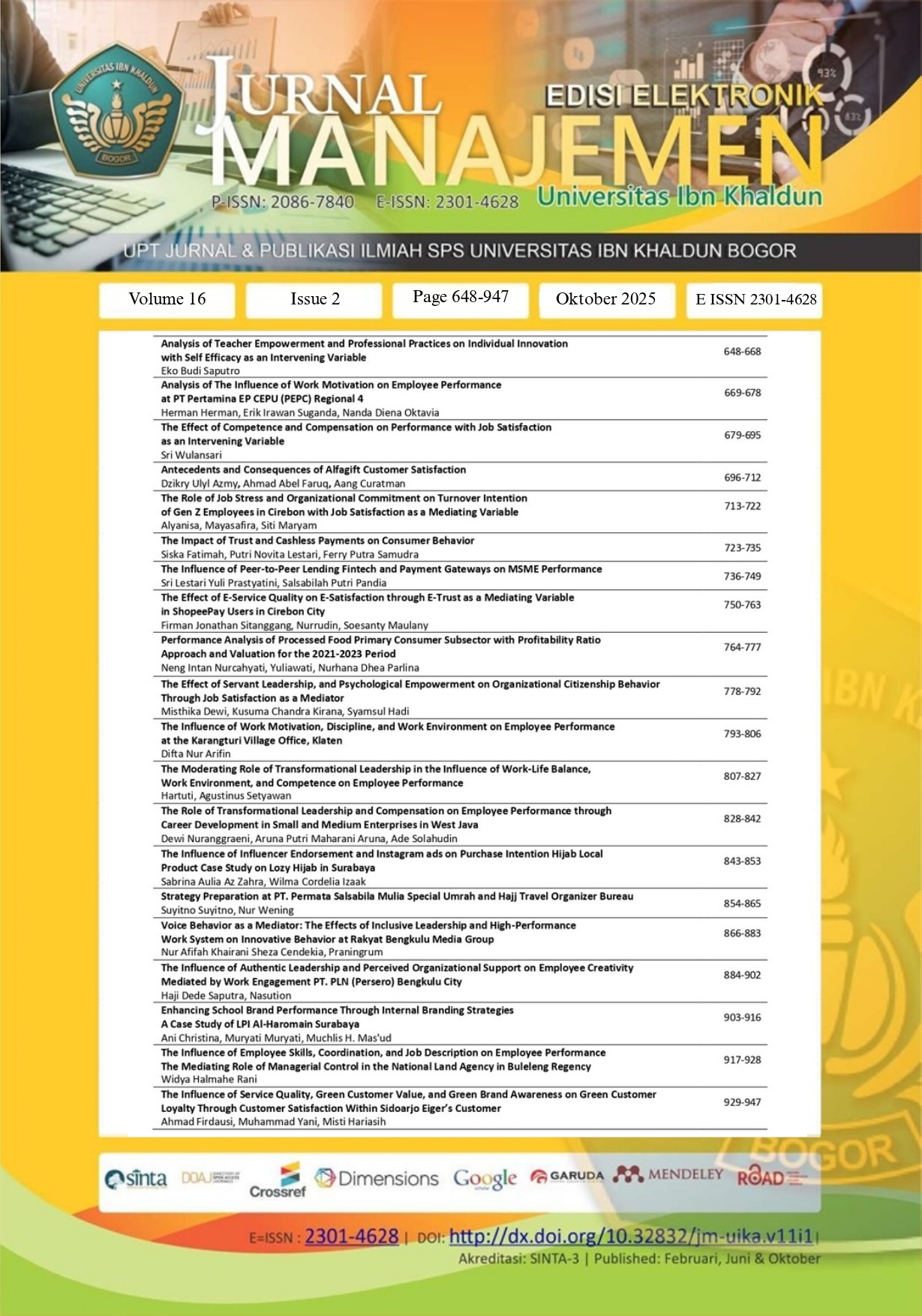
The Influence of Peer-to-Peer Lending Fintech and Payment Gateways on MSME Performance
DOI:
https://doi.org/10.32832/jm-uika.v16i2.19811Keywords:
Fintech Peer to Peer Lending, Payment Gateways, MSME PerformanceAbstract
The goal of this research is to find out how much of an impact payment gateways and peer-to-peer lending have on the efficiency of MSMEs in Yogyakarta's Kota Gede. This study will use positivist-based quantitative methods to investigate a preselected community or sample. Kota Gede Yogyakarta Silver MSMEs make up the population studied in this research. One of the most popular tourist attractions and a major cash cow for Yogyakarta is its silver craft, which is why it's important to sample silver MSMEs. This study implemented a purposive sampling technique and had certain criteria for sample selection. For this study 57 MSMEs located in Perak Kota Gede Yogyakarta Silver were surveyed. This research utilized multiple linear regression analysis for its data. The findings indicate that payment gateways and peer-to-peer financing impact the operational efficiency of small and medium enterprises located in Perak, Kota Gede, Yogyakarta substantially. The F test results indicate a substantial difference between the F table value and the F computed value. Apart from the other, both payment gateways and peer-to-peer financing significantly influence the growth of micro, small, and medium enterprises and are regarded as separate independent variables.
References
Baihaqi, J. (2018). Sharia-based Financial Technology Peer-To-Peer Lending in Indonesia. Tawazun: Journal of Sharia Economic Law, 1(2). http://journal.stainkudus.ac.id/index.php/tawazun/index
Błach, J. (2011). FINANCIAL INNOVATIONS AND THEIR ROLE IN THE MODERN FINANCIAL SYSTEM - IDENTIFICATION AND SYSTEMATIZATION OF THE PROBLEM. In Financial Internet Quarterly (Vol. 7). www.e-finanse.com
Buana, U., Karawang, P., & Article, H. (2023). The Effect of Digital Payment Gateway (OVO) on the Financial Performance of MSMEs Umniyah1, Dedi Mulyadi2.
Chandrawan, D., Widjojo, J., Program, A. M., Accounting, S., & Madani, B. (2023). Financal Technology Peer-to-Peer Lending as One of the Financing Solutions for MSMEs 56 FINANCIAL TECHNOLOGY PEER-TO-PEER LENDING AS ONE of the Financing Solutions for MSMEs.
Edison, A. (2016). PERFORMANCE MEASUREMENT DESIGN WITH BALANCED SCORECARD METHOD AND PRIORITIZATION OF ANALYTICAL HIERARCHY PROCESS (CASE STUDY AT PT. ANDROMEDA GALACTICORP SURABAYA).
Eriza et al. (2024). The Effect of Payment Gateway and Financial Literacy on Financial Performance in MSME Actors in Kebonsari Village. SCIENTIFIC JOURNAL OF ECONOMICS AND MANAGEMENT, 2 (7), 549-599. https://doi.org/10.61722/jiem.v2i7.2127
Gainau, P. C. (2023). The Effect of Financial Technology on the Performance of Micro, Small and Medium Enterprises (MSMEs). https://doi.org/10.47065/ekuitas.v5i1.3778
Ghozali. (2018). CHAPTER III RESEARCH METHODS.
Gopang, M. A., Nebhwani, M., Khatri, A., & Marri, H. B. (2017). An assessment of occupational health and safety measures and performance of SMEs: An empirical investigation. Safety Science, 93, 127-133. https://doi.org/10.1016/j.ssci.2016.11.024
Hidayatullah, A. (2024). The Effect of Fintech Peer to Peer Lending and Fintech Payment on MSME Performance Mediated by E-Commerce Post Covid-19. Journal of Financial and Business Accounting, 17 (1). https://doi.org/10.35143/jakb.v17i1.6160
Hsueh et al. (2017). Alternative and nonregulatory approaches to environmental governance. Article in Journal of Public Administration Research and Theory. https://doi.org/10.1093/jopart/muw042
Ministry of Tourism and Creative Economy. (2022). Kotagede Silver Craft: Global Competitiveness of Yogyakarta's Distinctive Jewelry.
Kurniawan, D., Zusrony, E., & Kusumajaya, R. (2018). ANALYSIS OF USER PERCEPTIONS OF PAYMENT GATEWAY SERVICES.
Lalita, S. F., Zahra, D. R., & Fabian, S. S. (2024). The Effect of Financial Technology Peer to Peer Lending and Electronic Money (E-Money) on Economic Growth in Indonesia (2021-2023).
Lestari, D. A., Purnamasari, E. D., & Setiawan, B. (2020). The Effect of Payment Gateway on the Financial Performance of MSMEs (Vol. 1, Issue 1).
Maysaroh et al. (2022). The Effect of Peer to Peer Lender (P2P) and Payment Gateway on MSME Performance during the Covid-19 Pandemic with E-commerce as a Moderating Variable. Business Management Journal, 18(2), 131. https://doi.org/10.30813/bmj.v18i2.3021
Museum. (2023, June 8). The Development of Kotagede Silver and the Traditional Technology Proficiency Cluster of Kotagede Museum.
Mutegi, H. K., Njeru, P. W., & Ongesa, N. T. (2015). FINANCIAL LITERACY AND ITS IMPACT ON LOAN REPAYMENT BY SMALL AND MEDIUM ENTERPRENUERS AN ANALYSIS OF THE EFFECT OF BOOK KEEPING SKILLS FROM EQUITY GROUP FOUNDATION'S FINANCIAL LITERACY TRAINING PROGRAM ON ENTERPRENEURS' LOAN REPAYMENT PERFORMANCE. In International Journal of Economics, Commerce and Management United Kingdom: Vol. III. http://ijecm.co.uk/
Prasetyo, Y., & Sutopo, J. (2020). IMPLEMENTATION OF PAYMENT GATEWAY SERVICES IN PAYMENT TRANSACTION INFORMATION SYSTEMS.
Royanti et al. (2023). The Effect of Payment Gateway on Financial Performance in Palembang City MSMEs. Al-Kharaj: Journal of Economics, Finance & Islamic Business, 5(5), 2366-2374. https://doi.org/10.47467/alkharaj.v5i5.3450
Saputra, I. (2019). ANALYSIS OF THE EFFECTIVENESS OF USING DIGITAL PAYMENT.
Sobihin, A. (2021). ANALYSIS OF THE INFLUENCE OF PEER TO PEER LENDING.
Suryawati, D. P. P. (2021). Analysis of the impact of peer-to-peer (P2P) lending on MSME business development. TIJAB (The International Journal of Applied Business), 5(2), 201-214.
Tampubolon, H. R. (2019). THE INS AND OUTS OF PEER TO PEER LENDING AS A NEW FORM OF FINANCE IN INDONESIA. Journal of Bina Mulia Hukum, 3(2), 188-198. https://doi.org/10.23920/jbmh.v3n2.15
Wahyudiati et al. (2018). THE EFFECT OF FINANCIAL ASPECT AND HUMAN RESOURCE COMPETENCE ON UMKM PERFORMANCE IN KASONGAN VILLAGE THE EFFECT OF FINANCIAL ASPECT AND HUMAN RESOURCE COMPETENCE ON UMKM PERFORMANCE IN KASONGAN VILLAGE.
Vishnu et al. (2024). The History of Kotagede as a Silver Center in Jogja.
Downloads
Published
How to Cite
Issue
Section
License
Copyright (c) 2025 Jurnal Manajemen (Edisi Elektronik)

This work is licensed under a Creative Commons Attribution-NonCommercial 4.0 International License.
Authors who publish with this journal agree to the following terms:
- Authors retain copyright and grant the journal right of first publication with the work simultaneously licensed under a Creative Commons Attribution-NonCommercial-ShareAlike 4.0 International License that allows others to share the work with an acknowledgement of the work's authorship and initial publication in this journal.
- Authors can enter into separate, additional contractual arrangements for the non-exclusive distribution of the journal's published version of the work (e.g., post it to an institutional repository or publish it in a book), with an acknowledgement of its initial publication in this journal.
- Authors are permitted and encouraged to post their work online (e.g., in institutional repositories or on their website) prior to and during the submission process, as it can lead to productive exchanges, as well as earlier and greater citation of published work (See The Effect of Open Access).