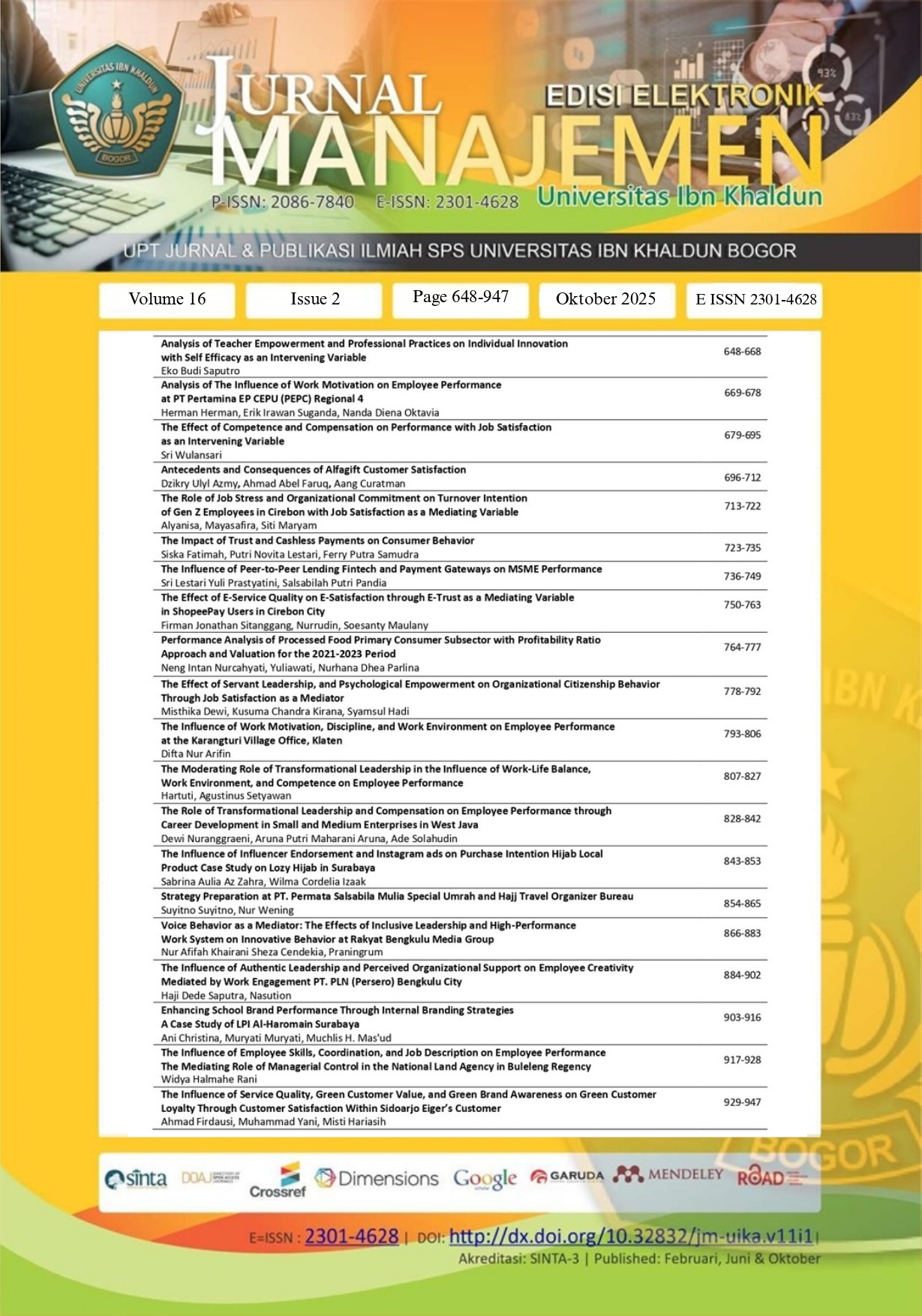
Voice Behavior as a Mediator: The Effects of Inclusive Leadership and High-Performance Work System on Innovative Behavior at Rakyat Bengkulu Media Group
DOI:
https://doi.org/10.32832/jm-uika.v16i2.20723Keywords:
inclusive, innovative, voice, HPWSAbstract
This quantitative study aims to investigate the influence of inclusive leadership and high-performance work systems (HPWS) on employees’ innovative behavior, with voice behavior acting as a mediating variable at Rakyat Bengkulu Media Group. The probability sampling method used in this study uses a cluster sampling method and Hair's formula to make sure that there are at least 237 workers in the sample. It was possible to gather information by giving out surveys. Structural Equation Modeling (SEM) research with the SmartPLS 3 software was used to look at the data in this work. The study's results are as follows: (1) inclusive leaership have a positive and significant effect on innovative behavior; (2) high-performance work systems have a positive and significant effect on employee innovative behavior; (3) inclusive leadership has no effect on voice behavior; (4) high-performance work systems have a positive and significant effect on voice behavior; (5) voice behavior has a positive and significant effect on employee innovative behavior; (6) inclusive leadership has no effect on employee innovative behavior with voice behavior as a mediating variable; and (7) high performance work system have a positive and significant effect on employee innovative behavior with voice behavior as a mediating variable. It is expected that the findings of this study will contribute to resolving the challenges encountered by the Rakyat Bengkulu Media Group. The Group’s primary objectives are to address issues related to inclusive leadership, high-performance work systems, and the influence of voice behavior on employee innovation.
References
Afsar, B., Shahjehan, A., Shah, S. I., & Wajid, A. (2019). The mediating role of transformational leadership in the relationship between cultural intelligence and employee voice behavior: A case of hotel employees. International Journal of Intercultural Relations, 69, 66–75. https://doi.org/10.1016/j.ijintrel.2019.01.001
Alfes, K., Veld, M., & Fürstenberg, N. (2021). The relationship between perceived high‐performance work systems, combinations of human resource well‐being and human resource performance attributions and engagement. Human Resource Management Journal, 31(3), 729–752. https://doi.org/10.1111/1748-8583.12310
Arshad, B., Hassan, H., & Azam, A. (2024). The impact of employees’ experiance of high-performance work systems on innovative behavior in professional service firms. Frontiers in Psychology, 14, 1324474. https://doi.org/10.3389/fpsyg.2023.1324474
Badru, A. F., Karadas, G., & Olugbade, O. A. (2022). Employee voice: the impact of high-performance work systems and organisational engagement climate. The Service Industries Journal, 1–29. https://doi.org/10.1080/02642069.2022.2056163
Bataineh, M. S. E., Zainal, S. R. M., Muthuveloo, R., Yasin, R., Wali, J. Al, & Mugableh, M. I. (2022). Impact of inclusive leadership on adaptive performance: The role of innovative work behaviour. Int. Journal of Business Science and Applied Management, 17(1).
Botero, I. C., & Van Dyne, L. (2009). Employee Voice Behavior. Management Communication Quarterly, 23(1), 84–104. https://doi.org/10.1177/0893318909335415
Botha, L., & Steyn, R. (2022). Employee voice and innovative work behaviour: empirical evidence from South Africa. Cogent Psychology, 9(1). https://doi.org/10.1080/23311908.2022.2080323
Caniëls, M. C. J., & Veld, M. (2019). Employee ambidexterity, high performance work systems and innovative work behaviour: How much balance do we need? The International Journal of Human Resource Management, 30(4), 565–585. https://doi.org/10.1080/09585192.2016.1216881
Carmeli, A., Reiter-Palmon, R., & Ziv, E. (2010). Inclusive leadership and employee involvement in creative tasks in the workplace: The mediating role of psychological safety. Creativity Research Journal, 22(3), 250–260. https://doi.org/10.1080/10400419.2010.504654
Chen, L., Li, M., Wu, Y. J., & Chen, C. (2021). The voicer’s reactions to voice: an examination of employee voice on perceived organizational status and subsequent innovative behavior in the workplace. Personnel Review, 50(4), 1073–1092. https://doi.org/10.1108/PR-07-2019-0399
Crant, J. M., Kim, T. Y., & Wang, J. (2011). Dispositional Antecedents of Demonstration and Usefulness of Voice Behavior. Journal of Business and Psychology, 26(3), 285–297. https://doi.org/10.1007/s10869-010-9197-y
Ehrnrooth, M., Koveshnikov, A., Balabanova, E., & Wechtler, H. (2023). High-performance work system and transformational leadership for employee constructive voice: unique and relative importance in a high-power distance context. The International Journal of Human Resource Management, 34(20), 3893–3932. https://doi.org/10.1080/09585192.2022.2163418
Escribá-Carda, N., Balbastre-Benavent, F., & Teresa Canet-Giner, M. (2017). Employees’ perceptions of high-performance work systems and innovative behaviour: The role of exploratory learning. European Management Journal, 35(2), 273–281. https://doi.org/10.1016/j.emj.2016.11.002
Escribá-Carda, N., Canet-Giner, T., & Balbastre-Benavent, F. (2023). The role of engagement and knowledge-sharing in the high-performance work systems–innovative behaviour relationship. European Journal of Management and Business Economics. https://doi.org/10.1108/EJMBE-07-2022-0206
Falih Bannay, D., Jabbar Hadi, M., & Abdullah Amanah, A. (2020). The impact of inclusive leadership behaviors on innovative workplace behavior with an emphasis on the mediating role of work engagement. Problems and Perspectives in Management, 18(3), 479–491. https://doi.org/10.21511/ppm.18(3).2020.39
Fang, Y.-C., Chen, J.-Y., Wang, M.-J., & Chen, C.-Y. (2019). The Impact of Inclusive Leadership on Employees’ Innovative Behaviors: The Mediation of Psychological Capital. Frontiers in Psychology, 10, 1803.
Ghozali, I., & Laten, H. (2015). Partial least squares konsep, teknik dan aplikasi menggunakan program SmartPLS 3.0 untuk penelitian empiris (Ed.2). Badan Penerbit Universitas Diponegoro.
Guo, Y., Zhu, Y., & Zhang, L. (2022). Inclusive leadership, leader identification and employee voice behavior: The moderating role of power distance. Current Psychology, 41(3), 1301–1310. https://doi.org/10.1007/s12144-020-00647-x
Guzman, F. A., & Espejo, A. (2019). Introducing changes at work: How voice behavior relates to management innovation. Journal of Organizational Behavior, 40(1), 73–90. https://doi.org/10.1002/job.2319
Haar, J., O’Kane, C., & Daellenbach, U. (2022). High performance work systems and innovation in New Zealand SMEs: testing firm size and competitive environment effects. The International Journal of Human Resource Management, 33(16), 3324–3352. https://doi.org/10.1080/09585192.2021.1894213
Han, Q., & Xia, L. (2020). Social media use and employee innovative behavior: The mediating role of employee voice. An International Journal, 48(3), 1–7. https://doi.org/10.2224/sbp.9014
Imran, R., & Al-Ansi, K. S. H. (2019). High Performance Work System, Job Engagement and Innovative Work Behavior: An Exploration in Omani Context. In Proceedings of the 2019 2nd International Conference on Computers in Management and Business, 24–28. https://doi.org/10.1145/3328886.3328893
Jabbar, J. A., Haider, S., & Qureshi, M. U. (2023). Moderated Mediation between High Performance Work System (HPWS) and Employee Voice Behavior: The Role of Psychological Safety and Supportive Leadership. Journal of Work and Organizational Psychology, 39(3), 145–156.
Javed, B., Khan, A. K., & Quratulain, S. (2018). Inclusive Leadership and Innovative Work Behavior: Examination of LMX Perspective in Small Capitalized Textile Firms. The Journal of Psychology, 152(8), 594–612. https://doi.org/10.1080/00223980.2018.1489767
Jiang, J., Ding, W., Wang, R., & Li, S. (2022). Inclusive leadership and employees’ voice behavior: A moderated mediation model. Current Psychology, 41(9), 6395–6405. https://doi.org/10.1007/s12144-020-01139-8
Jin, X., Qing, C., & Jin, S. (2022). Ethical Leadership and Innovative Behavior: Mediating Role of Voice Behavior and Moderated Mediation Role of Psychological Safety. Sustainability, 14(9), 5125. https://doi.org/10.3390/su14095125
Jolly, P. M., & Lee, L. (2021). Silence is not Golden: Motivating Employee Voice through Inclusive Leadership. Journal of Hospitality & Tourism Research, 45(6), 1092–1113. https://doi.org/10.1177/1096348020963699
Jong, J. P. . de, & Hartog, D. N. Den. (2008). Innovative Work Behavior: Measurement and Validation.
Kremer, H., Villamor, I., & Aguinis, H. (2019). Innovation leadership: Best-practice recommendations for promoting employee creativity, voice, and knowledge sharing. Business Horizons, 62(1), 65–74. https://doi.org/10.1016/j.bushor.2018.08.010
Lee, S. E., & Dahinten, V. S. (2021). Psychological Safety as a Mediator of the Relationship Between Inclusive Leadership and Nurse Voice Behaviors and Error Reporting. Journal of Nursing Scholarship, 53(6), 737–745. https://doi.org/10.1111/jnu.12689
Li, H., & Hang, Y. (2017). A Study of the Influence of Inclusive Leadership on Employee Voice Behaviors: the Mediating Effect of LMX. Proceedings of the 2017 2nd International Conference on Education, Management Science and Economics (ICEMSE 2017). https://doi.org/10.2991/icemse-17.2017.70
Liu, C., Wu, M., & Chen, X. (2023). A chain mediation model of inclusive leadership and voice behavior among university teachers: evidence from China. Scientific Reports, 13(1), 22377. https://doi.org/10.1038/s41598-023-50018-2
Lukes, M., & Stephan, U. (2017). Measuring employee innovation. International Journal of Entrepreneurial Behavior & Research, 23(1), 136–158. https://doi.org/10.1108/IJEBR-11-2015-0262
Mansoor, A., Wahab, S. A., & Jahan, S. (2021). STIMULATION OF INNOVATIVE BEHAVIOR THROUGH THE INCLUSIVE LEADERS AND ENGAGED WORKERS. Business: Theory and Practice, 22(2), 249–255. https://doi.org/10.3846/btp.2021.13363
Manzoor, A., John, A., & Chaudhary, S. (2024). Central Lancashire Online Knowledge ( CLoK ) Avoidance Job Crafting and Employee Innovative Behavior : A Moderated Mediation Analysis.
Miao, R., Lu, L., Cao, Y., & Du, Q. (2020). The High-Performance Work System, Employee Voice, and Innovative Behavior: The Moderating Role of Psychological Safety. International Journal of Environmental Research and Public Health, 17(4), 1150. https://doi.org/10.3390/ijerph17041150
Mowbray, P. K., Wilkinson, A., & Tse, H. H. M. (2021). High-performance work systems and employee voice behaviour: an integrated model and research agenda. Personnel Review, 50(6), 1530–1543. https://doi.org/10.1108/PR-12-2019-0692
Nawaz, K., & Khan, H. (2023). THE HIGH-PERFORMANCE WORK SYSTEM & INNOVATIVE PERFORMANCES: MEDIATING ROLE OF VOICE OPPORTUNITY. Journal of Social Research Development, 4(4), 656–668. https://doi.org/10.53664/JSRD/04-04-2023-01-656-668
Qi, L., & Liu, B. (2017). Effects of Inclusive Leadership on Employee Voice Behavior and Team Performance: The Mediating Role of Caring Ethical Climate. Frontiers in Communication, 2. https://doi.org/10.3389/fcomm.2017.00008
Rajandran, K., & Subramaniam, A. (2023). HOW INCLUSIVE LEADERSHIP CATALYZE INNOVATIVE WORK BEHAVIOUR: THE MODERATING EFFECT OF PSYCHOLOGICAL OWNERSHIP. International Online Journal of Educational Leadership, 7(1), 51–67.
Randel, A. E., Galvin, B. M., Shore, L. M., Ehrhart, K. H., Chung, B. G., Dean, M. A., & Kedharnath, U. (2018). Inclusive leadership: Realizing positive outcomes through belongingness and being valued for uniqueness. Human Resource Management Review, 28(2), 190–203. https://doi.org/10.1016/j.hrmr.2017.07.002
Rasheed, M. A., Shahzad, K., Conroy, C., Nadeem, S., & Siddique, M. U. (2017). Exploring the role of employee voice between high performance work system and organizational innovation in small and medium enterprises. Journal of Small Bussines and Enterprise Development, 24(4), 670–688. https://doi.org/10.1108/JSBED-11-2016-0185
Saleem, T., Um-e-Rubbab, Shabab, H., & Irshad, M. (2023). High-Performance Work System and Innovative Work Behavior: The Mediating Role of Knowladge Sharing and Moderating Role of Inclusive Leadership. International Journal of Business and Economic Affairs, 8(1), 43–59. https://doi.org/10.24088/IJBEA-2023-81005
Shahzad, K., Arenius, P., Muller, A., Rasheed, M. A., & Bajwa, S. U. (2019). Unpacking the relationship between high-performance work systems and innovation performance in SMEs. Personnel Review, 48(4), 977–1000. https://doi.org/10.1108/PR-10-2016-0271
Shakil, R. M., Memon, M. A., & Ting, H. (2021). Inclusive leadership and innovative behaviour: the mediating role of job autonomy. Quality & Quantity.
Siregar, Z. M. E., Suryana, Ahman, E., & Senen, S. H. (2019). Factors Influencing Innovative Work Behavior: An Indivisual Factors Perspective. International Journal Of Scientific & Technology Research, 8(9), 324–2327.
Wahid, I. S., & Hyams-Ssekasi, D. (2018). Impact of HPWS on employees’ performance within the Bangladeshi telecom sector. Journal for Global Business Advancement, 11(4), 516–543. https://doi.org/10.1504/JGBA.2018.097181
Wang, C.-H., Baba, V. V., Hackett, R. D., & Hong, Y. (2019). Employee-experienced High-performance Work Systems in Facilitating Employee Helping and Voice: The Role of Employees’ Proximal Perceptions and Trust in the Supervisor. Human Performance, 32(2), 69–91. https://doi.org/10.1080/08959285.2019.1587765
Ye, Q., Wang, D., & Guo, W. (2019). Inclusive leadership and team innovation: The role of team voice and performance pressure. European Management Journal, 37(4), 468–480. https://doi.org/10.1016/j.emj.2019.01.006
Zhou, W., & Velamuri, V. K. (2018). Key contextual success factors for employee innovative behavior: A study in a foreign manufacturing subsidiary in China. Cogent Business & Management, 5(1), 1471770. https://doi.org/10.1080/23311975.2018.1471770
Downloads
Published
How to Cite
Issue
Section
License
Copyright (c) 2025 Jurnal Manajemen (Edisi Elektronik)

This work is licensed under a Creative Commons Attribution-NonCommercial 4.0 International License.
Authors who publish with this journal agree to the following terms:
- Authors retain copyright and grant the journal right of first publication with the work simultaneously licensed under a Creative Commons Attribution-NonCommercial-ShareAlike 4.0 International License that allows others to share the work with an acknowledgement of the work's authorship and initial publication in this journal.
- Authors can enter into separate, additional contractual arrangements for the non-exclusive distribution of the journal's published version of the work (e.g., post it to an institutional repository or publish it in a book), with an acknowledgement of its initial publication in this journal.
- Authors are permitted and encouraged to post their work online (e.g., in institutional repositories or on their website) prior to and during the submission process, as it can lead to productive exchanges, as well as earlier and greater citation of published work (See The Effect of Open Access).