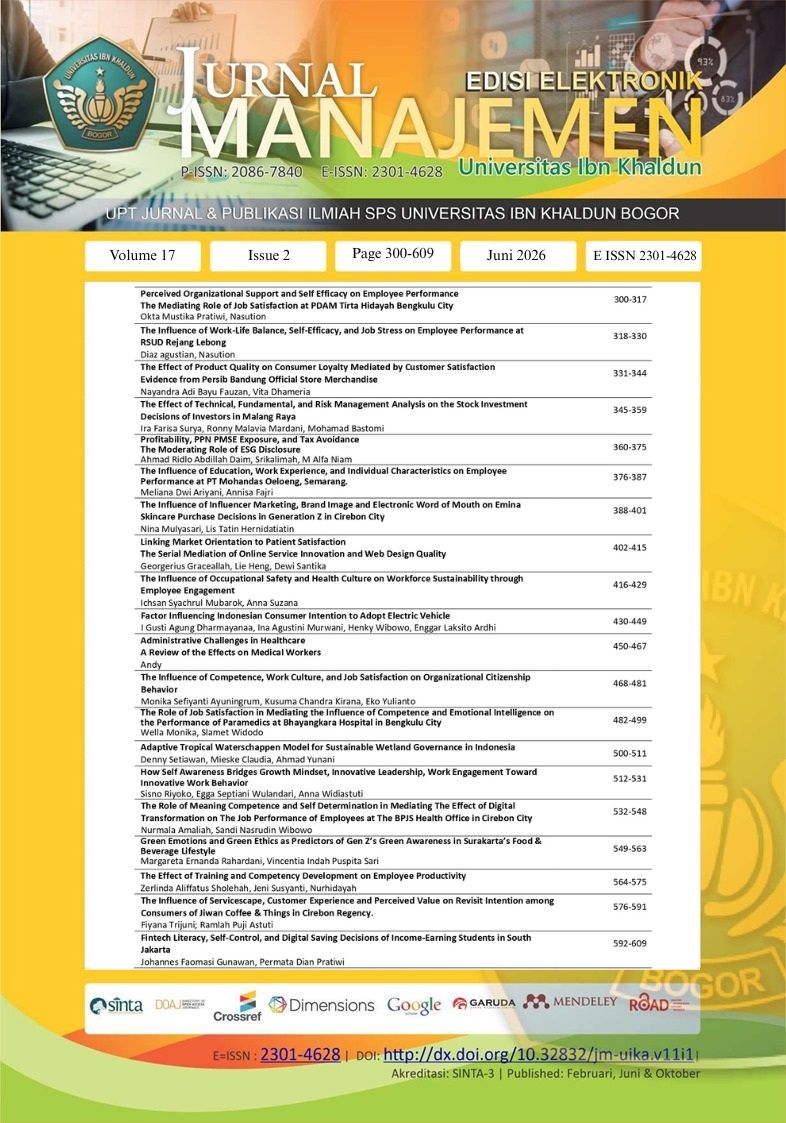
The Effect of Training and Competency Development on Employee Productivity
DOI:
https://doi.org/10.32832/jm-uika.v17i2.23129Keywords:
Training, Competency Development, Employee ProductivityAbstract
This research investigates the relationship between training, competency development, and employee productivity. Conducted at PT GMF Aeroasia, specifically within the Line Maintenance department in Denpasar, this study addresses the high-stakes operational environment where technical precision and efficiency are paramount. The primary objective is to evaluate how structured human capital interventions contribute to overall organizational productivity. The study employed a quantitative research design. Data were gathered through the distribution of structured questionnaires to employees, ensuring a representative sample of the technical workforce. The analytical framework utilized Structural Equation Modeling-Partial Least Square (SEM-PLS) to test the hypothesized relationships between the variables. This method allowed for a robust assessment of both direct effects and the measurement model’s validity. The empirical results reveal a nuanced picture of human resource dynamics. Training was found to have a positive and significant influence on employee productivity, suggesting that targeted skill acquisition and technical instruction directly translate into better operational output. In contrast, the analysis indicates that competency development does not have a significant impact on productivity in this specific context. This discrepancy suggests that while immediate technical training is effective, broader competency-based programs may not be optimally aligned with the immediate productivity demands of line maintenance operations. These findings provide important practical implications for management. The study highlights the necessity of prioritizing investment in continuous training programs to maintain high performance standards. Furthermore, it suggests that current competency development frameworks require a strategic reassessment to ensure better integrated with functional job requirements to effectively drive future productivity.
References
Anggraini, A., & Ansori, M. (2025). Optimalisasi Knowledge Management Kinerja Karyawan dalam Upaya Optimalisasi Knowledge Peningkatan KSPPS Artha Yasmin Az- Zahra Jepara. Jurnal Manajemen Dan Profesional (JPRO), 6(1), 32–54. https://doi.org/https://doi.org/https://doi.org/10.32815/jpro.v6i1.2380
Anggriani, R., & Inapty, B. A. (2025). Determinan kualitas pelaporan keuangan pada usaha mikro: studi Kota Mataram. REKAN Journal, 6(2), 217–230. https://doi.org/10.30812/rekan.v6i2.5300
Asia, G. A. (2024). Integrated Report 2024: Advancing Operational Agility and Transformation for a Future-Ready, Customer-Centric MRO.
Błaszczyk, M., Popović, M., Zajdel, K., & Zajdel, R. (2023). Implications of the COVID-19 Pandemic on the Organization of Remote Work in IT Companies: The Managers’ Perspective. Sustainability, 15(15). https://doi.org/https://doi.org/10.3390/su151512049
Ghozali, I., & Latan, H. (2014). Partial Least Squares Konsep, Metode dan Aplikasi Menggunakan Program WARPPLS 4.0, Edition: 2. Badan Penerbit Universitas Diponegoro.
Hartati, E. (2021). Analisis Pengukuran Model Sistem Pembelajaran Online Menggunakan Teori Jacob Nielsen. Klik: Jurnal Ilmu Komputer, 2(2), 27–35. www.untag-sby.ac.id
Ilahia, Y. F., Abidinb, M., Ekowatic, V. M., Indra, C., & Lesmanad. (2023). The Role of Micro, Small and Medium Enterprises (MSMEs) in Alleviating Poverty Caused by Unemployment. Jurnal Ekonomi Pembangunan, 21(2), 98–114.
Junaidin, B., Nanditaputra, D. S., Musyadad, H. F., Wahju, D., Santoso, & Sudibya, B. (2025). Semi Real-World Simulator: Media Pembelajaran Interaktif Kendali Pesawat Untuk Pelatihan Siswa Dan Komunitas Radio Control. Jurnal Abadimas Adi Buana, 9(1), 59–65.
Mariana, T., Pranitasari, D., Prastuti, D., Hermastuti, P., & Saodah, N. S. (2024). Pengaruh Beban Kerja, Pengembagan Karir, Srta Pelatihan Kerja Terhadap Kepuasan Kerja Karyawan PT. Bank Mandiri (Persero) Tbk. Media Manajemen Jasa, 12(1), 17–30.
Marliana, R. R. (2020). Partial Least Squares-Structural Equation Modeling Pada Hubungan Antara Tingkat Kepuasan Mahasiswa Dan Kualitas Google Classroom Berdasarkan Metode Webqual 4.0. Jurnal Matematika, Statistika Dan Komputasi, 16(2), 176. https://doi.org/10.20956/jmsk.v
Mikołajczyk, K. (2020). Changes in the approach to employee development in organisations as a result of the COVID-19 pandemic. Uropean Journal of Training and Development Emerald Publishing Limited. https://doi.org/DOI 10.1108/EJTD-12-2020-0171
Munawaroh, I., Iriany, I. S., & Hermina, T. (2023). Pengembangan sumber daya manusia dalam meningkatkan kinerja Amil Zakat. Journal Of Entrepeneurship and Strategic Management, 2(1), 1–9. https://digilib.uinsgd.ac.id/91115/%0Ahttps://digilib.uinsgd.ac.id/91115/4/4_BAB I.pdf
Putri, N. P. E. A. L., & Riana, I. G. (2025). Pengaruh Beban Kerja Terhadap Perilaku Cyberloafing Karyawan yang Dimediasi oleh Stres Kerja. E-Jurnal Manajemen, 14(8), 578–593. https://doi.org/https://doi.org/10.24843/EJMUNUD.2025.v14.i8.p01
Sembiring, M. A., Njatrijani, R., Zulfah, S., Wibowo, B. S., & Lutfiyani, F. (2024). Pengaturan Hukum dan Tanggung Jawab Komite Nasional Keselamatan Transportasi (KNKT) dalam Konteks Kecelakaan Pesawat Udara (Studi Kasus Jatuhnya SJ 182 di Perairan Kepulauan Seribu, Jakarta Utara). Law, Development & Justice Review, 7(2), 175–192.
Simbolon, O. J., Sitanggang, L., Trisanti, A., Sinurat, I., & Tarigan, M. I. B. (2026). Pengaruh Manajemen Pengetahuan Terhadap Kinerja Inovasi. Jurnal Akuntansi, Manajemen Dan Ilmu Ekonomi (JASMIEN), 5(8), 2723–8121.
Sun, X., Wandelt, S., & Zhang, A. (2020). COVID-19 pandemic and air transportation: Summary of Recent Research, Policy Consideration and Future Research Directions. Transportation Research Interdisciplinary Perspectives.
Sutrisna, & Aprilyani, N. (2021). Pengaruh Pelatihan dan Kompetensi Terhadap Produktivitas Karyawan Pada PT. Guna Karya Elektrik. Prosiding: Ekonomi Dan Bisnis, 1(1).
Wijaya, A. (2019). Metode Penelitian menggunakan Smart PLS 03. Innosain.
Yertas, M. (2024). The Role of Training and Continuous Development in Improving Employee Productivity and its Impact on Company Financial Performance. Atestasi : Jurnal Ilmiah Akuntansi, 7(2), 1362–1379. https://doi.org/10.57178/atestasi.v7i2.1047
Downloads
Published
How to Cite
Issue
Section
License
Copyright (c) 2026 Jurnal Manajemen

This work is licensed under a Creative Commons Attribution-NonCommercial 4.0 International License.
Authors who publish with this journal agree to the following terms:
- Authors retain copyright and grant the journal right of first publication with the work simultaneously licensed under a Creative Commons Attribution-NonCommercial-ShareAlike 4.0 International License that allows others to share the work with an acknowledgement of the work's authorship and initial publication in this journal.
- Authors can enter into separate, additional contractual arrangements for the non-exclusive distribution of the journal's published version of the work (e.g., post it to an institutional repository or publish it in a book), with an acknowledgement of its initial publication in this journal.
- Authors are permitted and encouraged to post their work online (e.g., in institutional repositories or on their website) prior to and during the submission process, as it can lead to productive exchanges, as well as earlier and greater citation of published work (See The Effect of Open Access).