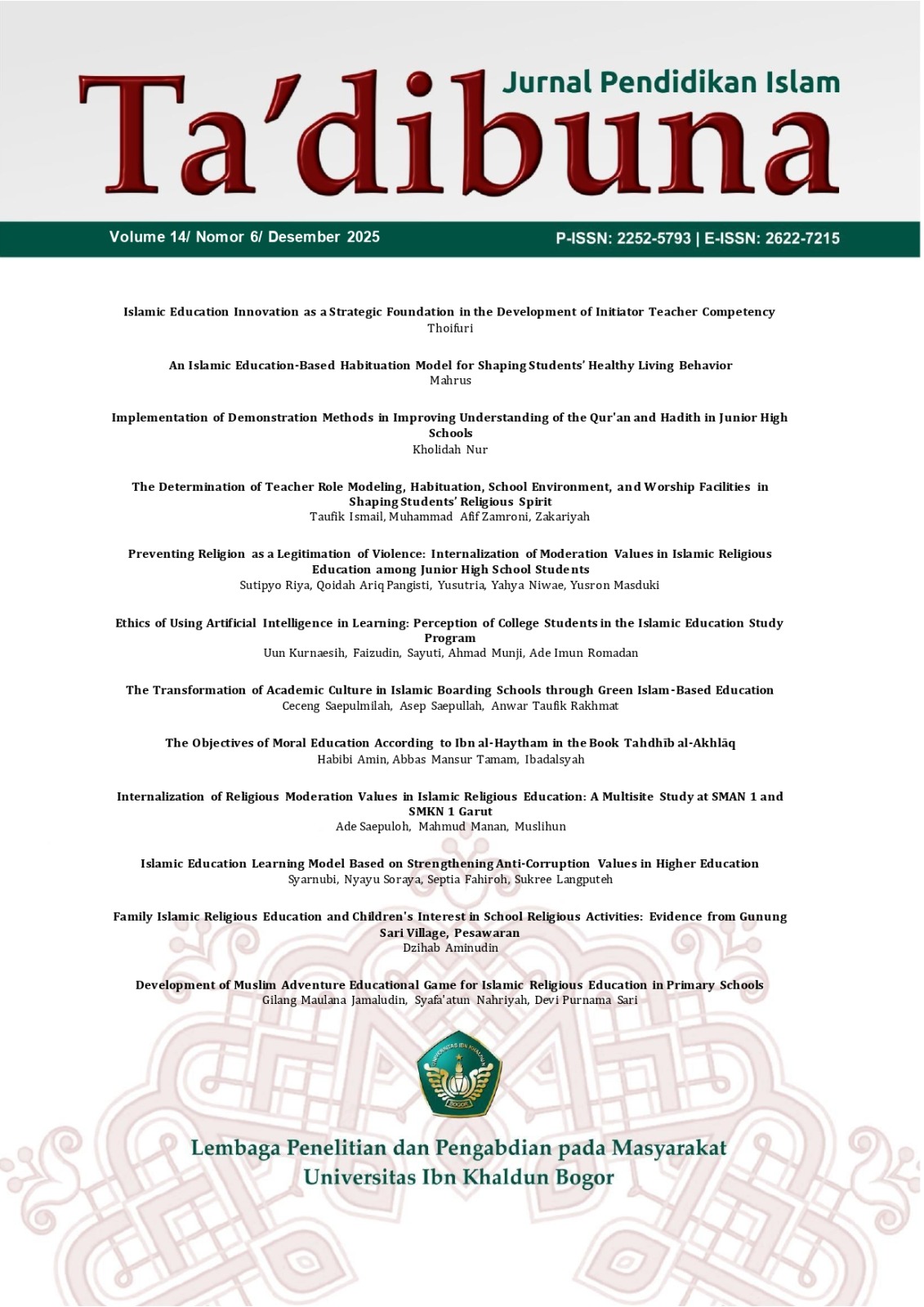
Development of Muslim Adventure Educational Game for Islamic Religious Education in Primary Schools
DOI:
https://doi.org/10.32832/tadibuna.v14i6.21708Keywords:
educational games, Islamic religious education, elementary schoolAbstract
The development of digital technology demands innovation in interactive learning media that are in line with the characteristics of the digital native generation. In Islamic Religious Education (PAI) learning in elementary schools, the use of conventional methods such as lectures and textbooks is still dominant, thus reducing student motivation and engagement. This study aims to develop a Muslim Adventure Educational Game as an innovative and engaging PAI learning medium. The research method uses research and development (R&D) with the ADDIE model. The research subjects involved 30 fifth-grade elementary school students in Majalengka Regency, who were tested through one-to-one, small group, and large-scale trials. Data were collected through needs questionnaires, validation by material experts, media, language, and student responses. The results showed that the game was categorized as very feasible with an average expert validation score of 4.55 and student responses of 4.15. These findings confirm that the integration of Islamic values in educational games can increase student interest and engagement in PAI learning.
References
Abdullah, A. C., & Amalia, P. (2025). The Effectiveness of Islamic Religious Education in Shaping the Religious Character of Elementary School Students. Zabags International Journal of Education, 3(1), 41–51.
Branch, R. M. (2010). Instructional design: The ADDIE approach. In Instructional Design: The ADDIE Approach. Springer US. https://doi.org/10.1007/978-0-387-09506-6
George-Reyes, C. E., López-Caudana, E. O., & Gómez-Rodríguez, V. G. (2024). Communicating educational innovation projects in Latin America mediated by the scaling of complex thinking: Contribution of the UNESCO-ICDE Chair in Mexico. Online Journal of Communication and Media Technologies, 14(3), e202434.
Giannakas, F., Kambourakis, G., Papasalouros, A., & Gritzalis, S. (2018). A critical review of 13 years of mobile game-based learning. Educational Technology Research and Development, 66(2), 341–384.
Hediansah, D., & Surjono, H. D. (2019). Building Motivation and Improving Learning Outcomes with Android-Based Physics Books: Education 4.0. Anatolian Journal of Education, 4(2), 1–10.
Jamaludin, G. M., Japar, M., & Sumantri, M. S. (2025). Digital Game-Based Learning in Education : A Visual Bibliometric Network Analysis. 2(April), 117–125.
Jamaludin, G. M., Japar, M., & Sumantri, M. S. (2026). VR-Edupanc: Development of a Virtual Reality-Based Digital Game Learning Model for Civic Education in Elementary Schools. Salud, Ciencia y Tecnología, 6, 2564–2564. https://doi.org/10.56294/SALUDCYT20262564
Kamila, A. (2023). Pentingnya pendidikan agama Islam dan pendidikan moral dalam membina karakter anak sekolah dasar. Al-Furqan: Jurnal Agama, Sosial, Dan Budaya, 2(5), 321–338.
Lampropoulos, G., & Kinshuk. (2024). Virtual reality and gamification in education: a systematic review. Educational Technology Research and Development, 72(3), 1691–1785.
Ordu, Y., & Çalışkan, N. (2023). The effects of virtual gaming simulation on nursing students’ diagnosis, goal setting, and diagnosis prioritization: A randomized controlled trial. Nurse Education in Practice, 68. https://doi.org/10.1016/j.nepr.2023.103593
Qutub, S. (2025). Efektivitas Penggunaan Aplikasi InVideo terhadap Peningkatan Minat Belajar Siswa dalam Pembelajaran PAI. Journal of Islamic Education Studies, 4(1), 71–80.
Razaghpoor, A., Taheri-Ezbarami, Z., Jafaraghaee, F., Maroufizadeh, S., & Falakdami, A. (2024). The effect of serious game and problem-based learning on nursing students’ knowledge and clinical decision-making skill regarding the application of transfusion medicine in pediatric nursing. Journal of Pediatric Nursing, 76, e1–e8. https://doi.org/10.1016/j.pedn.2024.01.010
Sari, D. P., & Jamaludin, G. M. (2025). Literature Review: Interactive Media of PAI Learning Based on Android Games Using the Game Development Life Cycle (GDLC) Method. Indonesian Journal of Islamic Education, 3(1), 1–6.
Siregar, B. J., Ndruru, L., & Tamba, S. P. (2021). Android-based learning media for vocational high school students. International Journal of Natural Science and Engineering, 5(2), 39–48.
Tomczyk, Ł. (2024). AI in Education-Mapping Theoretical Frameworks for Digital Literacy: DigComp 2.2, AI Literacy Competency Framework, AI Literacy TPACK, the Machine Learning Education Framework, the UNESCO AI Competency Framework for and Teachers and Other Innovative Approaches. International Conference on New Media Pedagogy, 173–191.
Triantafyllou, S. A., Georgiadis, C., & Sapounidis, T. (2025). Gamification in education and training: A literature review. International Review of Education, 1–35.
Tumangger, P. (2025). Pendidikan dalam Pembelajaran PAI di Sekolah Dasar: Analisis Praktik Pengajaran. Komprehensif, 3(1), 139–146.
Unal, E., Ozdemir, A., Aydın, M. O., & Alper, Z. (2024). Effect of standardized patient simulation with BCG vaccination on nursing students’ skills, knowledge and satisfaction, and self-confidence: A randomized controlled study. Nurse Education in Practice, 81. https://doi.org/10.1016/j.nepr.2024.104159
Yu, M., Yang, M., Ku, B., & Mann, J. S. (2021). Effects of Virtual Reality Simulation Program Regarding High-risk Neonatal Infection Control on Nursing Students. Asian Nursing Research, 15(3), 189–196. https://doi.org/10.1016/j.anr.2021.03.002
Downloads
Published
How to Cite
Issue
Section
License
Copyright (c) 2026 Ta'dibuna: Jurnal Pendidikan Islam

This work is licensed under a Creative Commons Attribution-ShareAlike 4.0 International License.
Penulis memberikan hak cipta karyanya kepada jurnal yang dilisensikan dengan CC-BY-SA or The Creative Commons Attribution–ShareAlike License yang memungkinkan orang lain untuk menggunakan karya dengan pengakuan kepengarangan karya dan publikasi awal dalam jurnal ini.