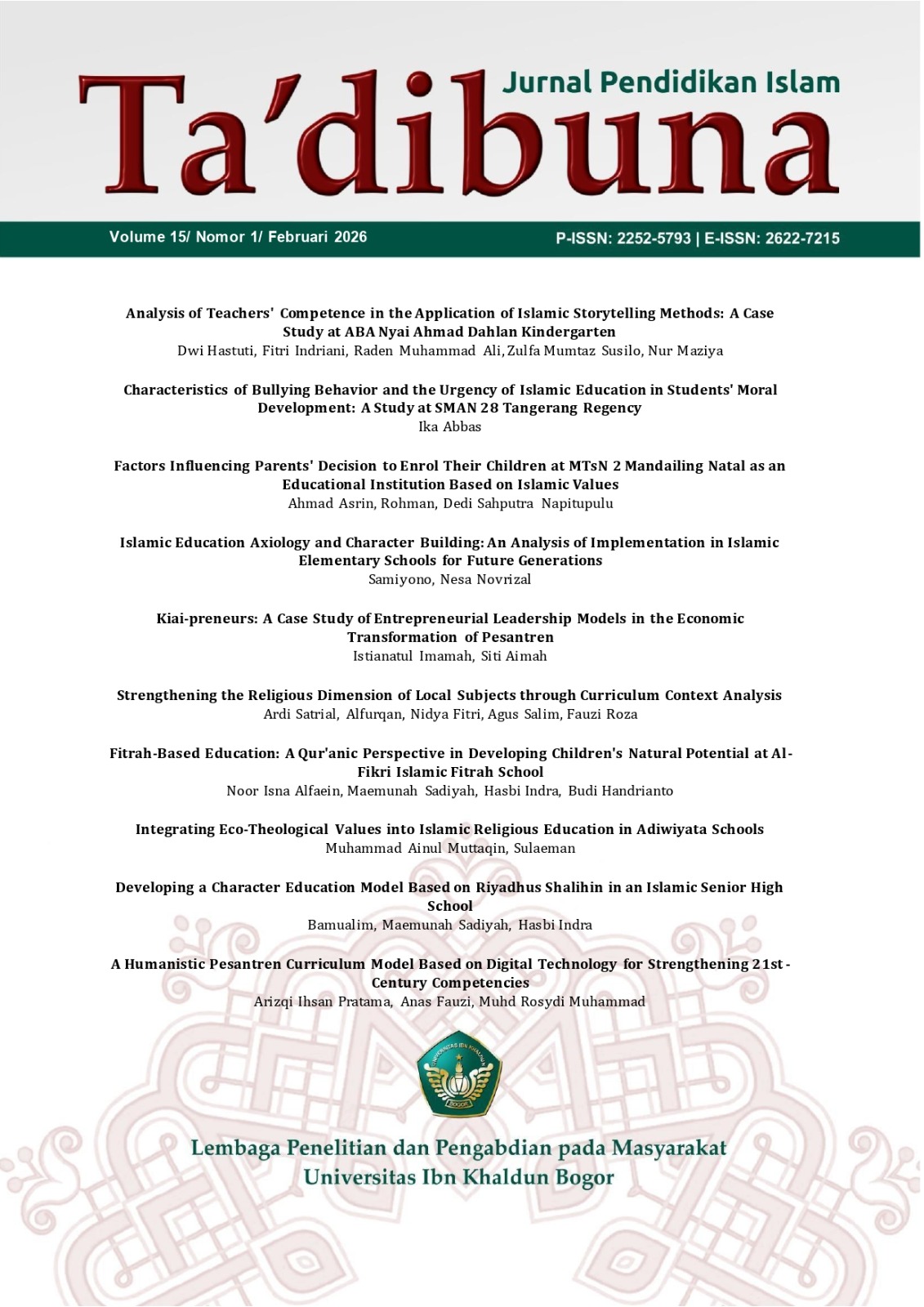
Islamic Education Axiology and Character Building: an Analysis of Implementation In Islamic Elementary Schools For Future Generations
DOI:
https://doi.org/10.32832/tadibuna.v15i1.22240Keywords:
Islamic education axiology, character education, Islamic elementary school, teacher role models, school cultureAbstract
This study evaluates how axiological values in Islamic education—such as worship, ihsan, amanah, and rahmatan lil-‘alamin—are operationalized in shaping the character of elementary school students. The main objective of this study is to explain the mechanism of value internalization and identify factors that strengthen the effectiveness of character education in the context of Islamic institutions. Using a library research approach with thematic analysis, this study collects and reviews the latest scientific sources, including peer-reviewed articles, academic books, and curriculum documents, to formulate a comprehensive understanding of the relationship between axiology and educational practice.
The results of the study reveal that the internalization of values is most effective when values are presented through experience-based learning, consistent habituation, and school activities oriented towards manners. Teacher role modeling emerges as the main medium that bridges the concept of values with the actual behavior of students, while a value-based school culture forms an ecosystem that allows values to become habitus. The synergy between schools, families, and communities has been proven to strengthen the continuity of values education outside the classroom. The discussion shows that the contribution of this study lies in the explicit integration between the axiological framework of Islamic education and character-building practices, an area that has been under-discussed in previous studies.
In conclusion, successful Islamic education is education that is able to present values as life experiences, not just normative instructions. This study offers implications for the development of value-based curricula and the improvement of teacher competence as moral models. Further research needs to examine the internalization of values in the digital context and develop evaluative instruments that are more sensitive to changes in student character.
Downloads
Published
How to Cite
Issue
Section
License
Copyright (c) 2026 Ta'dibuna: Jurnal Pendidikan Islam

This work is licensed under a Creative Commons Attribution-ShareAlike 4.0 International License.
Penulis memberikan hak cipta karyanya kepada jurnal yang dilisensikan dengan CC-BY-SA or The Creative Commons Attribution–ShareAlike License yang memungkinkan orang lain untuk menggunakan karya dengan pengakuan kepengarangan karya dan publikasi awal dalam jurnal ini.