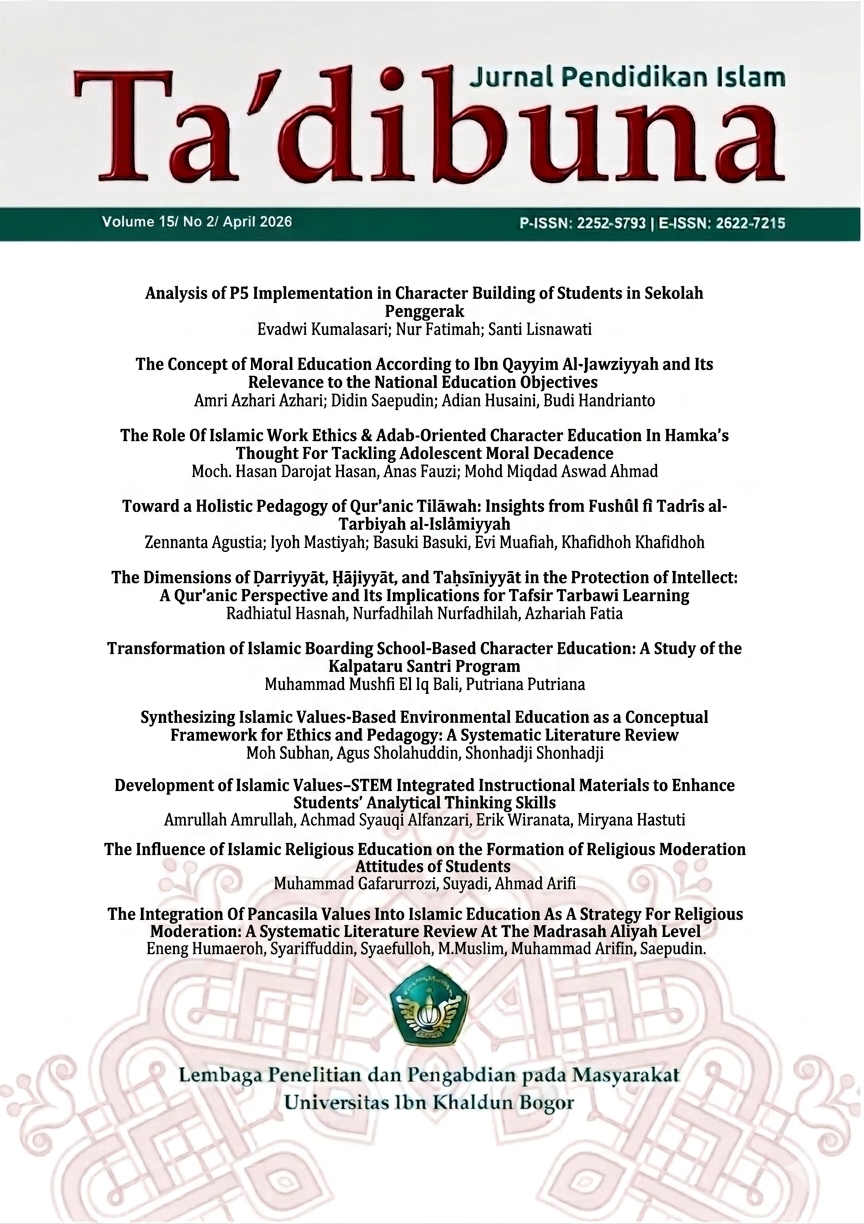
Toward a Holistic Pedagogy of Qur’anic Tilāwah: Insights from Fushûl fî Tadrîs al-Tarbiyah al-Islâmiyyah
DOI:
https://doi.org/10.32832/tadibuna.v15i2.22545Keywords:
Qur’anic tilāwah learning, Integration model, Objective learning, Fundamental learning principles, Methodological stepsAbstract
Qur’anic learning represents an Islamic educational system composed of interrelated components designed to support the realisation of educational objectives. These components include the goals, fundamental principles, and methodological steps. This study explores the Qur’anic tilâwah learning model conceptualised by Hasan Ja‘far al-Khalîfah and Kamâl al-Dîn Muhammad Hâsyim. This study employs library research, with the primary source being the book Fushûl fî Tadrîs al-Tarbiyah al-Islâmiyyah authored by Hasan Ja‘far al-Khalîfah and Kamâl al-Dîn Muhammad Hâsyim. Through content analysis, it was found that the model of tilâwah al-Qur’an learning encompasses seven learning objectives, seven fundamental principles that integrate technical, spiritual, and contextual dimensions, and five sequential methodological steps (opening, demonstration, discussion and explanation, practice, and evaluation). These components emphasise mastery of correct technical recitation while simultaneously internalising spiritual values and actualising the meanings of verses in real-life situations. The model of al-Khalîfah and Hâsyim reflects relevance and applicability in the contemporary era, particularly in addressing low Qur’anic literacy through a holistic and systematic approach that can be adapted to digital technology, social inclusion, and community-based initiatives.
Downloads
Published
How to Cite
Issue
Section
License
Copyright (c) 2026 Ta'dibuna: Jurnal Pendidikan Islam

This work is licensed under a Creative Commons Attribution-ShareAlike 4.0 International License.
Penulis memberikan hak cipta karyanya kepada jurnal yang dilisensikan dengan CC-BY-SA or The Creative Commons Attribution–ShareAlike License yang memungkinkan orang lain untuk menggunakan karya dengan pengakuan kepengarangan karya dan publikasi awal dalam jurnal ini.