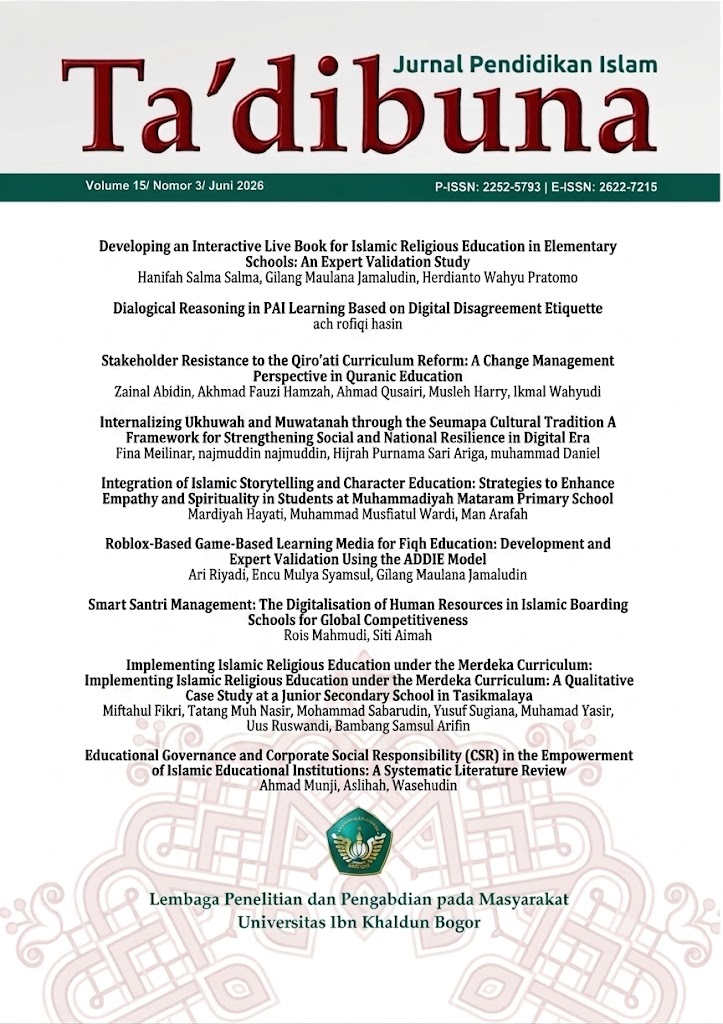
Stakeholder Resistance to the Qiro'ati Curriculum Reform: A Change Management Perspective in Quranic Education
DOI:
https://doi.org/10.32832/tadibuna.v15i3.23006Keywords:
Management of Change, Stakeholder Resistance, Curriculum Innovation, Quranic Education, Student RetentionAbstract
Curriculum innovation in Islamic educational institutions often faces significant challenges when the leadership's strategic vision does not align with stakeholder expectations. This study investigates the development of stakeholder opposition during the Pra PTPT Qiro'ati curriculum transition from six to five volumes at TPQ Madin Al Hidayah and its impact on the execution of curriculum reform. This innovation was developed by the institution’s leadership to expedite Quran literacy so that students could focus on the tahfidz program at the golden age of 10–12 years. But this policy caused anxiety among student guardians and led to students transferring to other institutions. Data were collected using a qualitative case study approach through in-depth interviews with 11 informants: one institutional leader, four teachers, and six parents, complemented by classroom observations and document analysis. The results of the research prove that the resistance comes from the failures of the unfreezing stage of change management, where the institution does not communicate the urgency of change effectively. The study also found that institutional leaders were concerned with long-term memorization readiness, and parents evaluated the quality of the curriculum primarily based on observable indicators of reading fluency and mastery of Qur’anic literacy. The difference in educational priorities created the gap in expectations, and this discrepancy caused decreasing trust in stakeholders and more student transfers. The study contributes to the literature on Islamic educational management by showing the importance of stakeholder involvement, internal communication, and trust formation in curriculum reform in Qur’anic educational institutions. Practical implications suggest the necessity of quality transparency and parental involvement in the curriculum transition process to ensure the sustainability of the institution
Downloads
Published
How to Cite
Issue
Section
License
Copyright (c) 2026 Ta'dibuna: Jurnal Pendidikan Islam

This work is licensed under a Creative Commons Attribution-ShareAlike 4.0 International License.
Penulis memberikan hak cipta karyanya kepada jurnal yang dilisensikan dengan CC-BY-SA or The Creative Commons Attribution–ShareAlike License yang memungkinkan orang lain untuk menggunakan karya dengan pengakuan kepengarangan karya dan publikasi awal dalam jurnal ini.