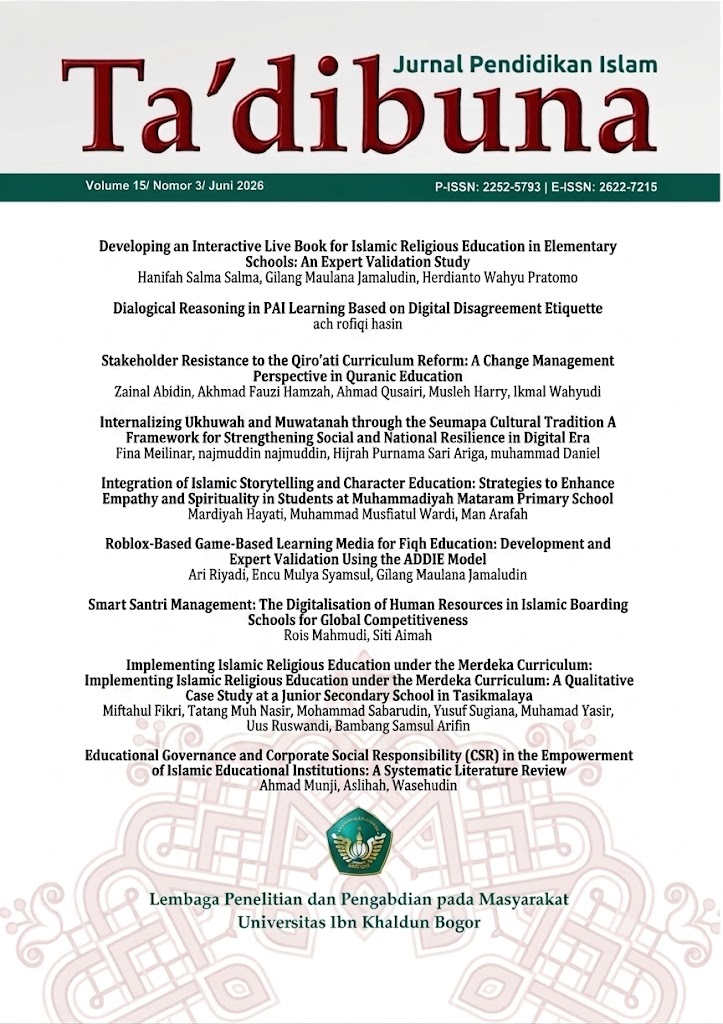
Dialogical Reasoning in PAI Learning Based on Digital Disagreement Etiquette
DOI:
https://doi.org/10.32832/tadibuna.v15i3.23601Abstract
Abstract
This study describes how students' dialogical reasoning is formed in Islamic Religious Education (PAI) through digital adab ikhtilaf. The research employed a qualitative case study in an Islamic educational institution in East Java from 1 to 28 May 2026. Data were gathered through interviews with the head of the institution, curriculum vice principal, PAI teachers, and ten students; classroom and school-environment observations; documentation; digital-media analysis; field notes; triangulation; and member checking. The findings show that dialogical reasoning emerged through respectful discussions, teacher modelling of ethical language, guided analysis of online religious content, tabayyun practice, attitude assessment, and reflective activities. Students demonstrated stronger listening, polite communication, and reflection, while reasoned argument, independent source checking, and separating criticism of ideas from personal attack still required sustained scaffolding. The study implies that PAI learning in digital contexts should integrate cognitive goals, ethical dialogue, and media-information literacy so that students can respond to religious differences critically, politely, and responsibly.
Keywords: adab ikhtilaf; case study; dialogical reasoning; digital literacy; Islamic Religious Education.
Downloads
Published
How to Cite
Issue
Section
License
Copyright (c) 2026 Ta'dibuna: Jurnal Pendidikan Islam

This work is licensed under a Creative Commons Attribution-ShareAlike 4.0 International License.
Penulis memberikan hak cipta karyanya kepada jurnal yang dilisensikan dengan CC-BY-SA or The Creative Commons Attribution–ShareAlike License yang memungkinkan orang lain untuk menggunakan karya dengan pengakuan kepengarangan karya dan publikasi awal dalam jurnal ini.