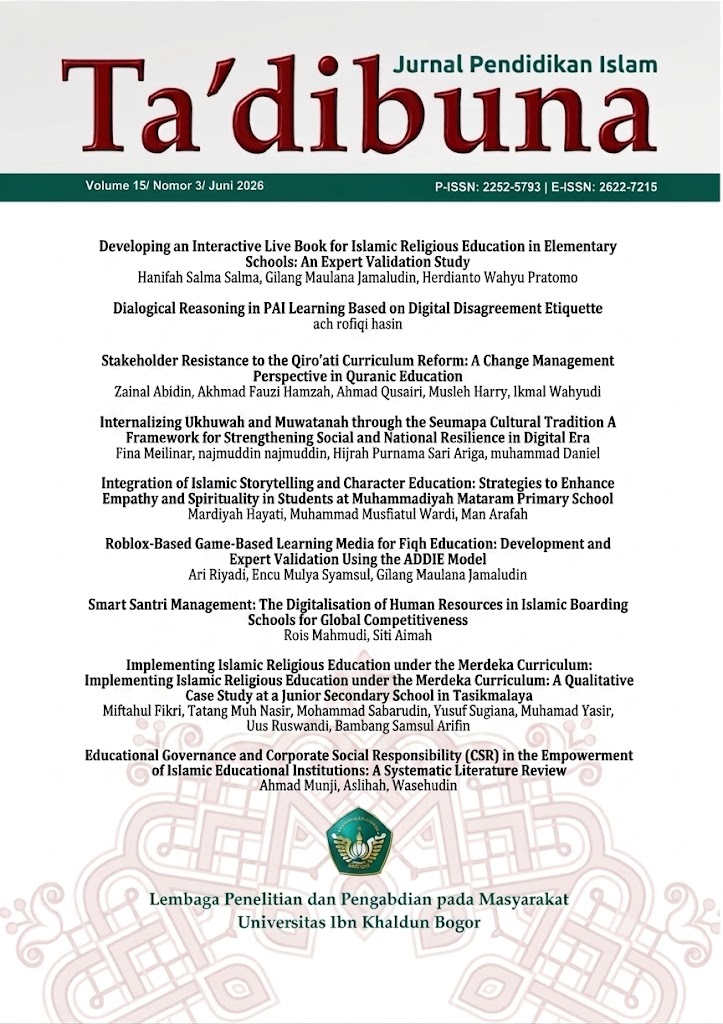
Developing an Interactive Live Book for Islamic Religious Education in Elementary Schools: An Expert Validation Study
DOI:
https://doi.org/10.32832/tadibuna.v15i3.23624Keywords:
Media Innovation;, Elementary School, Islamic EducationAbstract
Technological transformation has given rise to a generation of digital natives, characterize by a significant increase in internet users in Indonesia. This has brought about a new paradigm in the world of education, requiring learning to adapt to these developments. However, in reality, Islamic Religious Education in elementary schools is still dominated by conventional methods. This study aims to develop an interactive medium called Live Book as an innovation in digital literacy. The research method used is Research and Development (R&D) with the ADDIE development model; at this stage, the study is limited to the development phase (expert validation). The expert validation results showed a score of 4.90 for material content, 4.80 for media, and 4.90 for language. Content validity analysis using Aiken’s V coefficient yielded values of 0.975 for material, 0.950 for media, and 0.975 for language, all of which exceed the minimum significance threshold of 0.87, confirming that all three instrument are statistically feasible. The reliability of the validation instrument was measured using the Percentage of Agreement (PoA) method, yielding a PoA value of 100% across all the three expert validation (material, media, and language), which fall into the “Very Reliable” category and exceeds the minimum reliability threshold of 75%. This indicates that the development of Live Book has successfully integrated text narration, visual design, and interactive audio, making it highly suitable for use. This medium is designed to accommodate students’ visual-auditory learning styles, addressing boredom and enhancing learning motivation
Downloads
Published
How to Cite
Issue
Section
License
Copyright (c) 2026 Ta'dibuna: Jurnal Pendidikan Islam

This work is licensed under a Creative Commons Attribution-ShareAlike 4.0 International License.
Penulis memberikan hak cipta karyanya kepada jurnal yang dilisensikan dengan CC-BY-SA or The Creative Commons Attribution–ShareAlike License yang memungkinkan orang lain untuk menggunakan karya dengan pengakuan kepengarangan karya dan publikasi awal dalam jurnal ini.