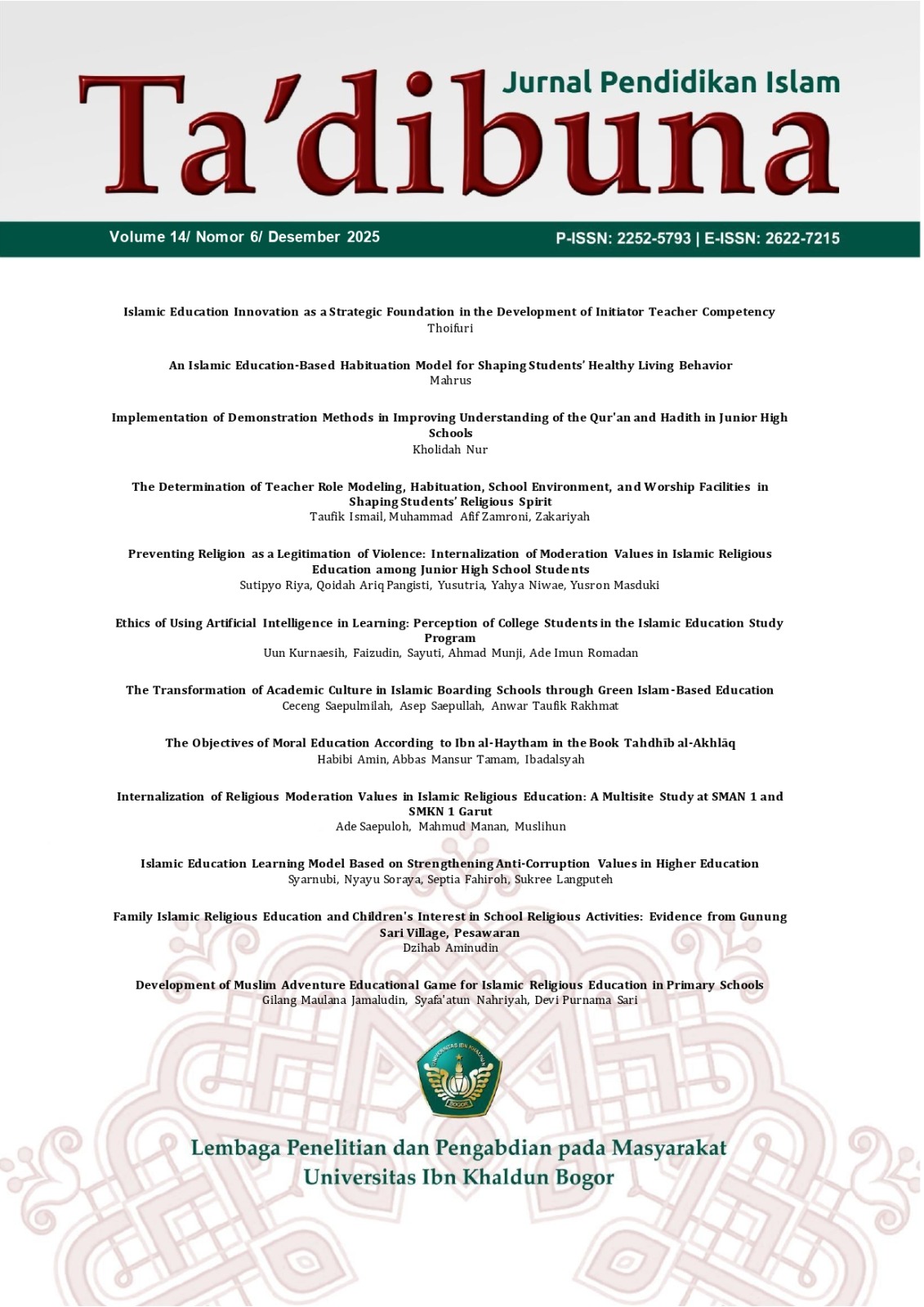
The Transformation of Academic Culture in Islamic Boarding Schools through Green Islam-Based Education
DOI:
https://doi.org/10.32832/tadibuna.v14i6.21827Keywords:
Green Islam, academic culture, pesantren, ethnography, eco-pesantrenAbstract
This study examines the transformation of academic culture at Pondok Pesantren Hamalatul Quran Manonjaya through the lens of Green Islam. The research focuses on practices of cleanliness, agriculture, leadership, and the role of ustadz/ustadzah (teachers) in fostering ecological awareness grounded in Islamic values. A qualitative ethnographic method was employed, involving 15 respondents comprising school leaders, teachers, administrators, and senior students. Data were collected through interviews, observations, and documentation, and subsequently analyzed thematically. The findings reveal that cleanliness is perceived as an integral part of faith; agricultural and greening activities function as ecological learning media; the pesantren’s leadership demonstrates a visionary approach with environmentally conscious policies; teachers integrate Islamic teachings into daily practices; while student discipline is maintained through humane and educational sanctions. This research concludes that Hamalatul Quran has successfully developed an eco-pesantren model grounded in Green Islam harmoniously integrating religious tradition, modernity, and ecological awareness in a sustainable manner.
References
Agama, I., Negeri, I., Islam, U., & Walisongo, N. (2023). Responsive Islamic Boarding School Management to Environmental Sustainability Through Green Islamic boarding School Program Nur Kasanah Muhammad Husain As Sajjad Dawam Multazamy Rohmatullah. 8.
Anas, M. (2017). Punishment From The Perspective Of Islamic Boarding School Education. 05, 1–20. https://doi.org/10.21274/taalum.2017.5.1.1-20
Armila, N., & Sopianingsih, V. (2022). The Transformational Leadership at Islamic Boarding Schools in the Digital Era. Tatar Pasundan: Journal of Religious Education and Training, 16(2), 146–163. https://doi.org/10.38075/tp.v16i2.307
Bourdieu, P. (o. J.). Outline Of A Of Practice.
Development, C. (2019). Modernization and Islamic boarding School Based Community Development in Indonesia Bambang Budiwiranto Universitas Islam Negeri Raden Intan Lampung A . Introduction Since the late 1970s community development has been promoted by non-government organisations in Indonesi. 2(1), 1–18.
Fikri, I., & Colombijn, F. (2021). Is Green Islam going to support environmentalism in Indonesia? Anthropology Today, 37(2), 15–18. https://doi.org/10.1111/1467-8322.12642
Haryanto Sri, N. (2022). Transformation of the Education System in Islamic Educational Sciences 12 University of Al-Qur’an Science, Wonosobo Email *): sriharyanto@unsiq.ac.id. Scaffolding: Journal of Islamic Education and Multiculturalism, 4(1), 397–404.
Holil, M., Asmuki, A., Mighfar, S., & Rafiqie, M. (2024). Development of Islamic Boarding School Typology: A Critique of Dhofier and Ziemek's Typology. 2(1), 45–53. https://doi.org/10.35316/jummy.v2i1.5428
Huda, A. N., Islam, U., Prof, N., & Saifudin, K. H. (2022). Dialectics of Islamic Boarding School Education in the Midst of the Society Era 5 . 0. 6(1), 1060–1067.
Java, W., Anwar, R., Java, W., Hakim, L., & Barat, J. (2023). The qur’anic learning based on islamic eco-theology at islamic boarding School. 9(2), 169–186. https://doi.org/10.15575/jpi.v9i2.24933
Komara, D., Kusuma, D. T., Nasir, T. M., Barat, J., Barat, J., Barat, J., Siliwangi, U., & Barat, J. (2025). Curriculum and Learning System of Al-Mahmud Tanjungsari Islamic Boarding School, Sumedang. 1, 62–70.
Lickona, T. (o. J.). Educating for Character.
Mainuddin, Ishomuddin, & Faridi. (2024). Sustainable Islamic Boarding Schools: Institutional Reform in Islamic Education. Alwatzikhoebillah Journal: Studies on Islam, Education, Economics, and Humanities, 10(2), 427–438. https://doi.org/10.37567/alwatzikhoebillah.v10i2.2631
Maulida, S. S., Nursaniah, C., & Sari, L. H. (2025). Implementation Of Eco-Islamic boarding School Through Green Building Concept At Islamic boarding School Modern Inshafuddin , Banda Aceh , Indonesia. 12(1), 205–224. https://doi.org/10.24191/myse.v12i1.1695
No Title. (o. J.).
Nurkhin, A., Martono, S., Ngabiyanto, N., Mukhibad, H., Rohman, A., & Kholid, A. M. (2023). Green Islamic boarding schools and environmental knowledge and awareness: Case study at As Salafy Al Asror Islamic Boarding School in Semarang. IOP Conference Series: Earth and Environmental Science, 1248(1). https://doi.org/10.1088/1755-1315/1248/1/012003
Education, J., & Islam, P. (2020). Environmental Education in. 11, 64–78. Author, K., & Dhofier, Z. (2022). Musala: Journal of Islamic Boarding Schools and Islamic Culture in the Archipelago https://jurnalannur.ac.id/index.php/musala. 1, 113–122.
Qadir, A. (2023). Ecopedagogy In Action : An Ethnographic Exploration Of Environmental Preservation Strategies In Islamic boarding School The transformation of traditional Islamic boarding schools ( islamic boarding School ) in Indonesia is marked by the emergence of eco-theology , a novel theologica. 9(2), 211–222. https://doi.org/10.15575/jpi.v9i2.29347
Qur, I. A. I. A.-, Application, D. A. N., & Islamic boarding School, D. I. (2024). Taujih Journal Islamic Education Journal Islamic Religious Education Study Program Physical Punishment in the Perspective of Islamic Education Taujih Journal Islamic Education Journal Islamic Religious Education Study Program. 6(01), 1–16.
Sofuoğ, H. (2025). Islamic Environmentalism in Indonesia : An Analytical Study of MUI Fatwas on Environmental Protection. 3(2), 177–202. https://doi.org/10.69526/bir.v3i2.168
Spradley, J. (2017). Review Reviewed Work ( s ): Participant Observation by Published by : The George Washington University Institute for Ethnographic Research. 53(March), 4–7. https://doi.org/10.2307/3318111
Supiana, A., Januaripin, M., Zaki, M., Hasan, A., & Hasyim, A. (2024). 1-The+Role+of+Islamic+Education+Environment+in+the+Modern+Era. 2(2), 183–193.
Syahdatul Maulida, & Mohammad Mahbubi Ali. (2023). Islamic boarding School in Indonesia and Sustainable Development Issues. The Economic Review of Islamic boarding School, 2(1). https://doi.org/10.58968/erp.v2i1.267
Translation of Ihya’ Ulumiddin 1.pdf. (o. J.).
Trimulyo, J., Rahmawati, I., Lestari, H., & Thelma, C. C. (2025). The Influence of Transformational Leadership on Fostering Management Innovation in Islamic Education Institutions. 09(01), 316–326.
Wijaya, I. S., Ridho, M., Hidayati, D. L., & Mahdi, M. (2024). Utilization of Digital Technology in Islamic Boarding Schools: A Case Study in Samarinda. Lentera: Journal of Islamic Propagation and Communication Sciences, 7(02), 140–153. https://doi.org/10.21093/lentera.v7i2.7390
Zegarra-salazar, N., Mendez-vergaray, J., Flores, E., & Flores, E. (2024). School restorative justice , restorative discipline rather than punishment : a systematic review. 13(3), 1775–1784. https://doi.org/10.11591/ijere.v13i3.25485
Downloads
Published
How to Cite
Issue
Section
License
Copyright (c) 2025 Ta'dibuna: Jurnal Pendidikan Islam

This work is licensed under a Creative Commons Attribution-ShareAlike 4.0 International License.
Penulis memberikan hak cipta karyanya kepada jurnal yang dilisensikan dengan CC-BY-SA or The Creative Commons Attribution–ShareAlike License yang memungkinkan orang lain untuk menggunakan karya dengan pengakuan kepengarangan karya dan publikasi awal dalam jurnal ini.