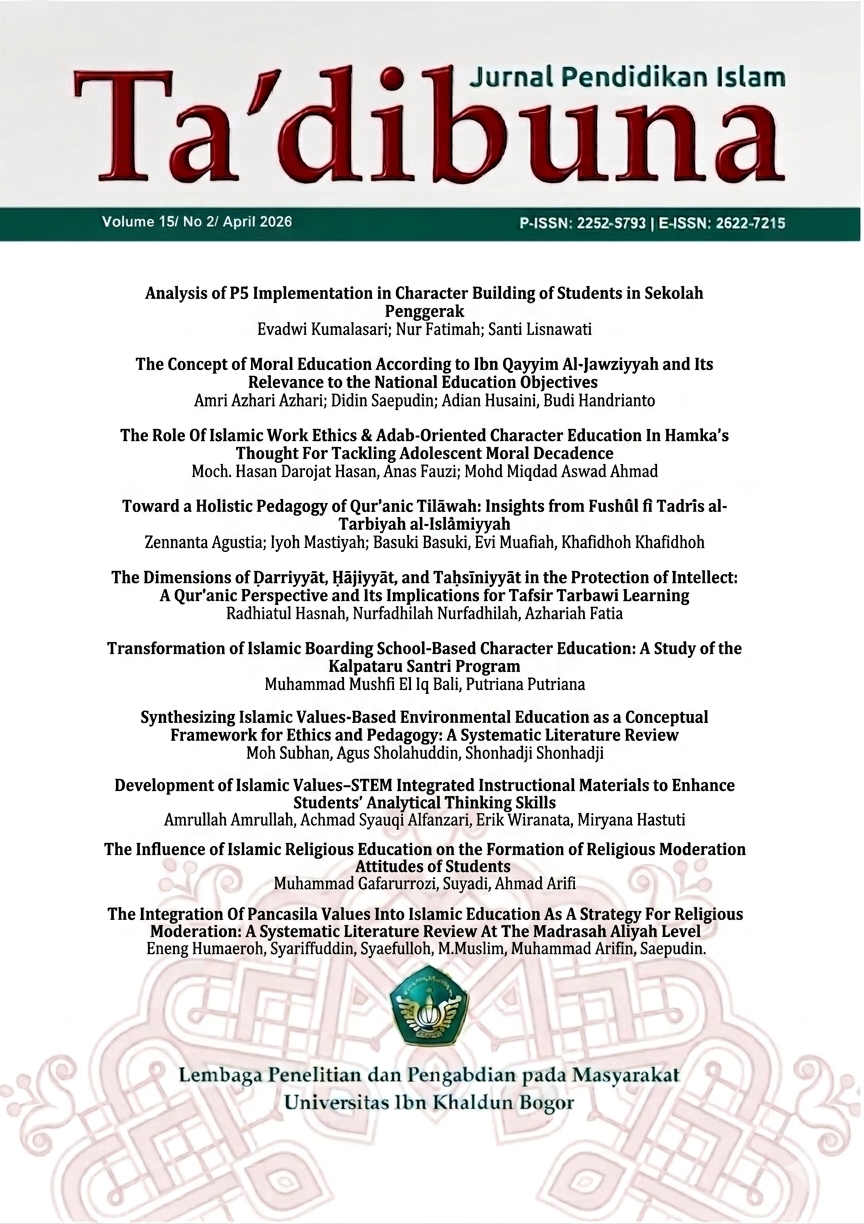
THE ROLE OF ISLAMIC WORK ETHICS & ADAB-ORIENTED CHARACTER EDUCATION IN HAMKA’S THOUGHT FOR TACKLING ADOLESCENT MORAL DECADENCE
DOI:
https://doi.org/10.32832/tadibuna.v15i2.22264Keywords:
Islamic Work Ethics, Hamka’s Thought, Adolescent Moral Decay, Educational Character DevelopmentAbstract
This study explores the intersection of Islamic Work Ethics (IWE) and adab-oriented character education, with a particular focus on the contributions of Hamka’s thought in addressing adolescent moral decadence. The review aims to synthesize existing research on the role of Islamic values in shaping both ethical behavior in organizational settings and moral development in educational contexts. Through a comprehensive analysis of empirical studies, the review identifies key theoretical frameworks, including Social Exchange Theory (SET) and Conservation of Resources Theory (COR), while highlighting significant gaps in the literature.
Using the PRISMA guidelines, the study systematically categorizes the reviewed articles based on methodology, context, and findings. Quantitative methods, particularly Structural Equation Modeling (SEM), dominate the field, with a notable concentration of studies in Muslim-majority countries like Pakistan, Indonesia, and Malaysia. While these studies underscore the relevance of Islamic ethics in promoting workplace integrity and character development, the review identifies a geographical gap, particularly in multicultural and non-Muslim-majority contexts.
The findings suggest that adab-oriented character education, rooted in Hamka’s principles, offers a novel framework for addressing adolescent moral decay in contemporary societies. Future research should explore the integration of IWE and adab education in multicultural settings, incorporating qualitative methods and examining the role of artificial intelligence (AI) in promoting ethical decision-making. This review contributes to the ongoing academic conversation on Islamic ethical frameworks, proposing new avenues for research to bridge cultural, geographical, and methodological gaps.
Downloads
Published
How to Cite
Issue
Section
License
Copyright (c) 2026 Ta'dibuna: Jurnal Pendidikan Islam

This work is licensed under a Creative Commons Attribution-ShareAlike 4.0 International License.
Penulis memberikan hak cipta karyanya kepada jurnal yang dilisensikan dengan CC-BY-SA or The Creative Commons Attribution–ShareAlike License yang memungkinkan orang lain untuk menggunakan karya dengan pengakuan kepengarangan karya dan publikasi awal dalam jurnal ini.