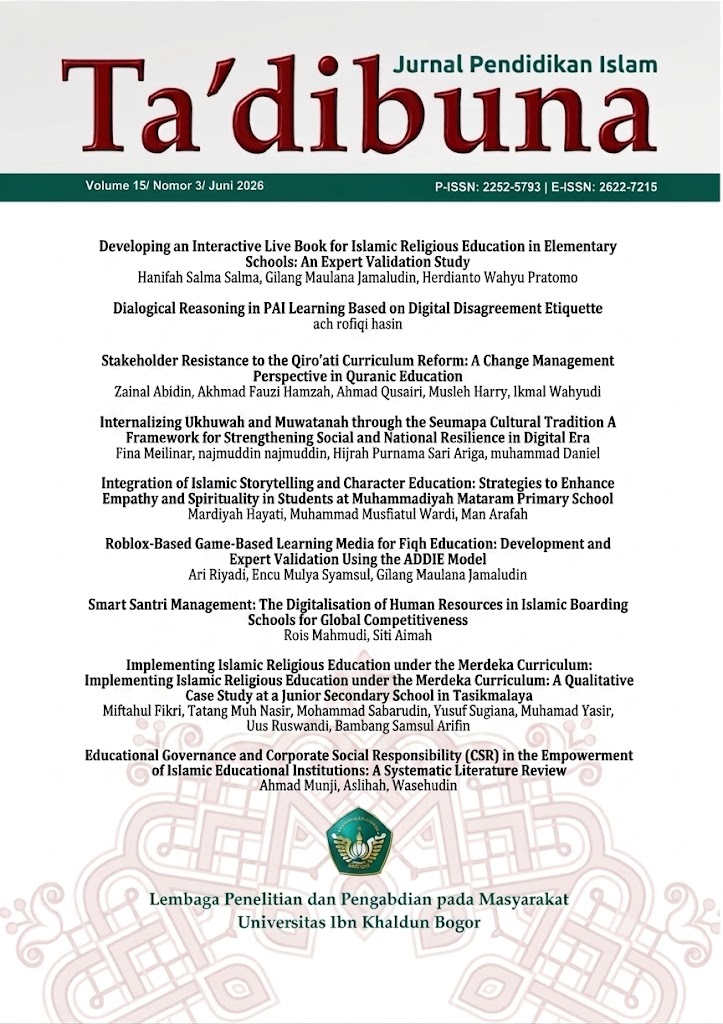
Integration of Islamic Storytelling and Character Education: Strategies to Enhance Empathy and Spirituality in Students at Muhammadiyah Mataram Primary School
DOI:
https://doi.org/10.32832/tadibuna.v15i3.23589Keywords:
Storytelling; Character Islamic; Spiritual Awareness; Enthusiasm StudentAbstract
This study aims to explore the strategies for integrating Islamic storytelling into character education at SD Muhammadiyah Mataram and to analyze its role in enhancing students’ empathy and spiritual awareness. This study employed a qualitative method with a descriptive approach. The research subjects consisted of homeroom teachers, Islamic education teachers, and students from grades III to V who were selected through purposive sampling. Data were collected through observation, interviews, and documentation. The data were analyzed using the Miles and Huberman model, which includes data collection, data reduction, data display, and conclusion drawing or verification. The findings indicate that the integration of Islamic storytelling in character education is able to create a more interactive and reflective learning environment. Students demonstrated positive responses, reflected in increased empathy, enthusiasm, active participation in discussions, and their ability to reflect on the spiritual values embedded in the stories. The implications of this study suggest that Islamic storytelling can serve as an effective pedagogical strategy for character education in elementary schools. Originality/value of this research lies in strengthening the integration of Islamic narrative-based learning as a humanistic and reflective approach to fostering students’ empathy and spirituality within the context of character education.
Downloads
Published
How to Cite
Issue
Section
License
Copyright (c) 2026 Ta'dibuna: Jurnal Pendidikan Islam

This work is licensed under a Creative Commons Attribution-ShareAlike 4.0 International License.
Penulis memberikan hak cipta karyanya kepada jurnal yang dilisensikan dengan CC-BY-SA or The Creative Commons Attribution–ShareAlike License yang memungkinkan orang lain untuk menggunakan karya dengan pengakuan kepengarangan karya dan publikasi awal dalam jurnal ini.