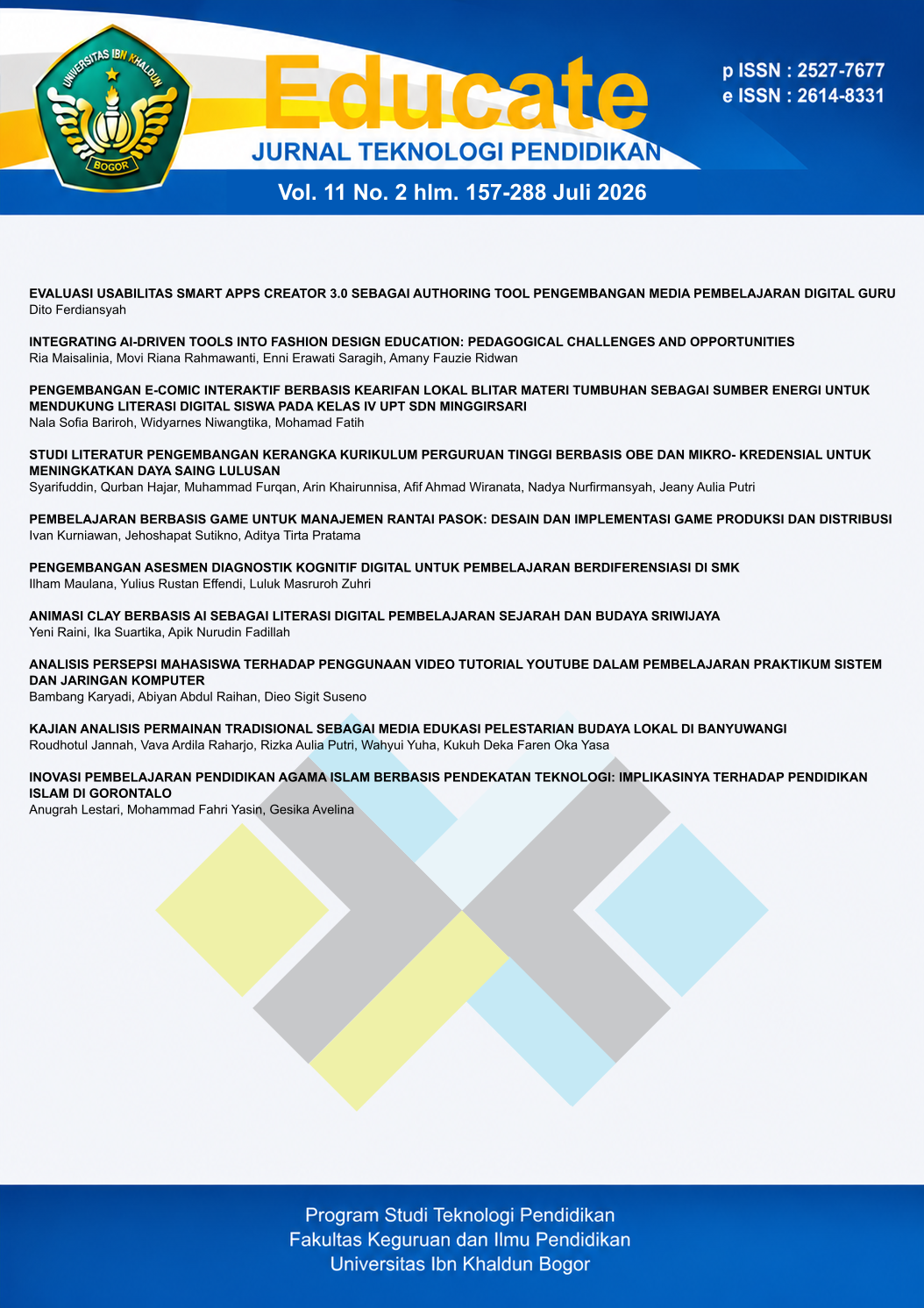
ANALISIS PERSEPSI MAHASISWA TERHADAP PENGGUNAAN VIDEO TUTORIAL YOUTUBE DALAM PEMBELAJARAN PRAKTIKUM SISTEM DAN JARINGAN KOMPUTER
DOI:
https://doi.org/10.32832/educate.v11i2.24730Kata Kunci:
YouTube, Persepsi Mahasiswa, Technology Acceptance Model (TAM), Praktikum Jaringan Komputer , Media Pembelajaran DigitalAbstrak
Mata kuliah Sistem dan Jaringan Komputer menuntut pemahaman visual dan prosedural yang mendalam, seperti penggunaan baris perintah (Command Line Interface / CLI), serta pemecahan masalah (troubleshooting) instalasi dan konfigurasi pada webserver dan database server. Penelitian ini bertujuan untuk menganalisis persepsi mahasiswa terhadap penggunaan video tutorial YouTube sebagai media pendukung pembelajaran mata kuliah sistem dan jaringan komputer. Dengan menggunakan pendekatan kuantitatif deskriptif berbasis kerangka Technology Acceptance Model (TAM), penelitian ini mengukur dua dimensi utama yaitu Kemudahan Penggunaan yang Dirasakan (Perceived Ease of Use) dan Kemanfaatan yang Dirasakan (Perceived Usefulness). Data dikumpulkan melalui kuesioner berskala Likert 1–5 yang disebarkan kepada 50 mahasiswa peserta mata kuliah praktikum jaringan komputer. Hasil penelitian menunjukkan bahwa persepsi mahasiswa berada pada kategori "Tinggi", dengan nilai rata-rata Perceived Ease of Use sebesar 3,81 (76,8%) dan Perceived Usefulness sebesar 3,72 (74,32%). Fleksibilitas akses lintas perangkat (HP/Laptop) dan kegunaan secara keseluruhan sebagai media pendukung utama diidentifikasi sebagai faktor kunci yang meningkatkan kemandirian praktikum dan keyakinan diri (self-efficacy) mahasiswa. Implikasi penelitian ini menyarankan integrasi playlist video terstruktur sebagai media komplementer resmi dalam modul praktikum vokasi dan teknik
Referensi
Purnamasari, & Hafnita. (2019). The Utilization of YouTube Media in Learning Antropology in Higher Education. International Conference on Education, Science and Technology, 5–10. https://doi.org/10.1088/1742-6596/1387/1/012120
Saurabh, S., & Gautam, S. (2019). Computers & Education Modelling and statistical analysisof YouTube ’ s educational videos : A channel Owner ’ s perspective. Computers & Education, 128(May 2018), 145–158. https://doi.org/10.1016/j.compedu.2018.09.003
Al-Maroof, R. S., Al-Emran, M., Khalil, A. I., & Shaalan, K. (2021). Acceptance of YouTube as an educational tool during the COVID-19 pandemic: A TAM-based study. Technology in Society, 67, 101780. https://doi.org/10.1016/j.techsoc.2021.101780
Syafrizal, A., Ernawati, E., & Dwiandiyanta, Y. (2016). Penerapan Model Technology Acceptance Model (TAM) untuk Pemahaman Media Pembelajaran Berbasis Multimedia Interaktif. Scientific Journal of Informatics, 2(1), 9-14. https://doi.org/10.15294/sji.v2i1.4524
Irmade, o. (2020). ANALISIS PERSEPSI PENGGUNAAN MEDIA YOUTUBE DALAM PEMBELAJARAN JASMANI SECARA MANDIRI MAHASISWA PG-PAUD. AWLADY: Jurnal Pendidikan Anak. 6(2), 223-233.
Alfayez, Z. (2021). Designing Educational Videos for University Websites Based on Students’ Preferences. Online Learning, 25(2). https://doi.org/10.24059/olj.v25i2.2232
Yusuf, M. (2011). The impact of self-efficacy, achievement motivation, and self- regulatedlearning strategies on students’ academic achievement. Procedia - Social and Behavioral Sciences, 15, 2623–2626. https://doi.org/10.1016/j.sbspro.2011.04.158
Amara, R., & Purmadi, A. (2025). EFEKTIVITAS PENGGUNAAN VIDEO TUTORIAL TERHADAP KETERAMPILAN MAHASISWA TEKNOLOGI PENDIDIKAN PADA MATA KULIAH PRAKTIK PERANCANGAN WEB PEMBELAJARAN. EDUCATOR : Jurnal Inovasi Tenaga Pendidik Dan Kependidikan, 5(2), 64–73. https://doi.org/10.51878/educator.v5i2.5668
Hadis, H. M., Fajriani, A. ., & Razilu, Z. . (2026). EFEKTIVITAS PENGGUNAAN YOUTUBE SEBAGAI MEDIA PEMBELAJARAN PADA MATA KULIAH FUNDAMEN TI POKOK BAHASAN JARINGAN DASAR . LEARNING : Jurnal Inovasi Penelitian Pendidikan Dan Pembelajaran, 6(2), 1129–1138. https://doi.org/10.51878/learning.v6i2.9703
Prayogi, R. A. (2025). Persepsi Mahasiswa Terhadap Penggunaan Youtube Dalam PerkuliahanBelajar Pembelajaran Di Perguruan Tinggi. Jurnal Pendidikan Ilmu Pengetahuan Sosial (JPIPS), 17(1), 1-9. https://doi.org/10.37304/jpips.v17i1.21254
Unduhan
Diterbitkan
Cara Mengutip
Terbitan
Bagian
Lisensi
Hak Cipta (c) 2026 Bambang Karyadi, Abiyan Abdul Raihan, Dieo Sigit Suseno

Artikel ini berlisensi Creative Commons Attribution 4.0 International License.
Penulis memberikan hak cipta karyanya kepada jurnal yang dilisensikan dengan CC-BY-SA or The Creative Commons Attribution–ShareAlike License yang memungkinkan orang lain untuk menggunakan karya dengan pengakuan kepengarangan karya dan publikasi awal dalam jurnal ini.