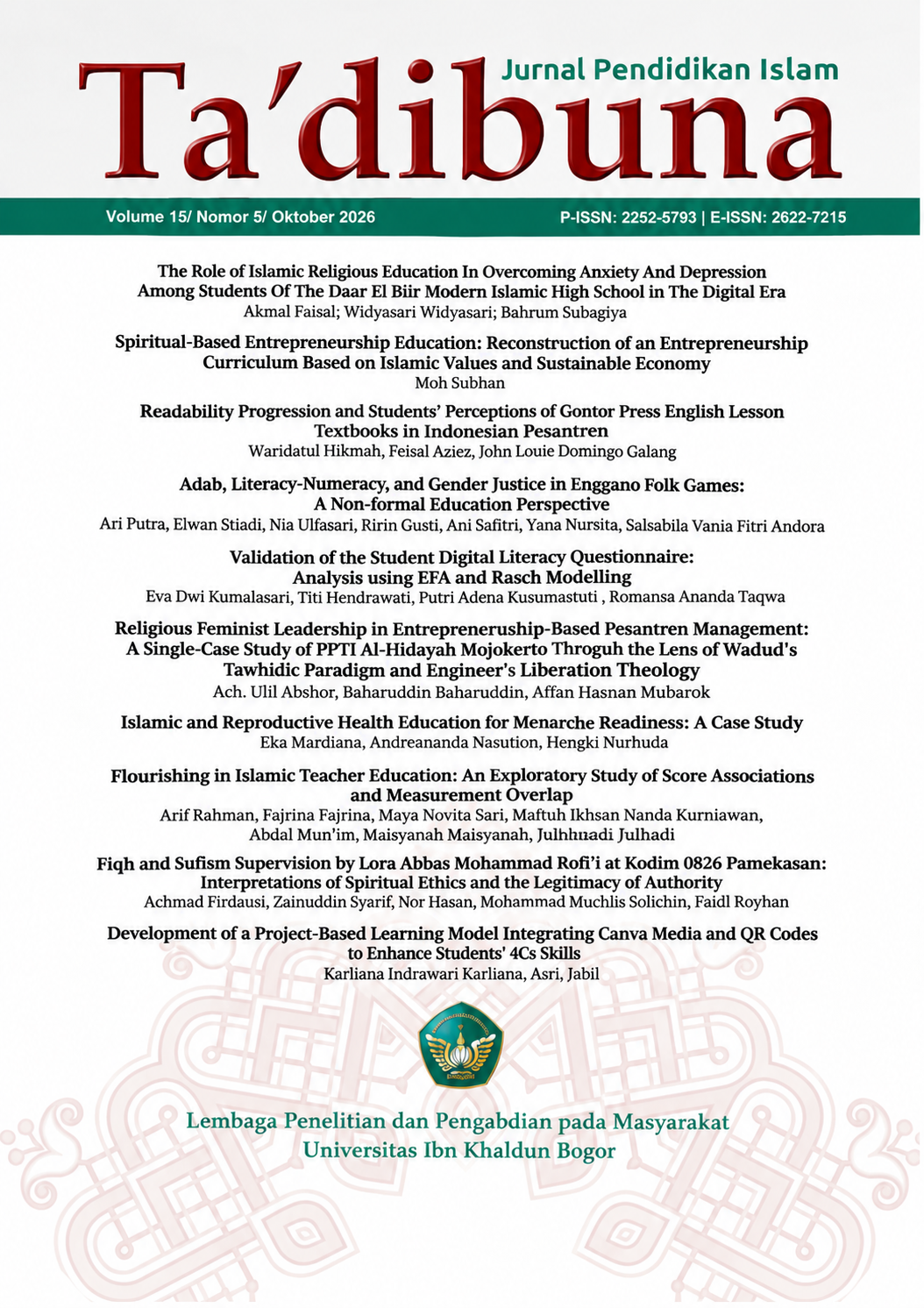
Fiqh and Sufism Supervision by Lora Abbas Mohammad Rofi’i at Kodim 0826 Pamekasan: Interpretations of Spiritual Ethics and the Legitimacy of Authority
DOI:
https://doi.org/10.32832/tadibuna.v15i5.24751Keywords:
Lora, Moderasi Beragama, Fiqih-Tasawuf, Otoritas Max Weber, Militer, NirkekerasanAbstract
This study examines the practice of fiqh and Sufism instruction conducted by Lora Abbas Mohammad Rofi’i at Military District Command (Kodim) 0826 Pamekasan, participants’ interpretations of ethical-spiritual values, and the relationship between the religious instructor’s legitimacy and the military’s institutional structure. Employing a qualitative single-case study design, the research draws on symbolic interactionism and Max Weber’s theory of authority. Data were collected through semi-structured interviews with eight informants, observations of religious study sessions, and documentation, and were analyzed thematically. Three main findings emerged. First, religious instruction was organized within the institution’s personnel development activities through the study of Fathul Muin and Irsyadul Ibad, using the traditional bandongan method followed by dialogue and questions related to military duties. Second, participants interpreted fiqh as a normative foundation for discipline, trustworthiness, and religious responsibility, while Sufism was understood as a means of self-reflection, self-control, and respect for others. Third, the acceptance of the lora was associated with legitimacy rooted in the Islamic boarding school tradition, the instructor’s communication skills, and institutional support from Kodim, while formal authority remained within the military structure. This study contributes empirical insights into nonformal Islamic education, ethical-spiritual meaning-making, and the legitimacy of local religious authority in a military setting. Although the findings are relevant to the values of religious moderation, they do not establish measurable changes in military personnel’s behavior.
Downloads
Published
How to Cite
Issue
Section
License
Copyright (c) 2026 Ta'dibuna: Jurnal Pendidikan Islam

This work is licensed under a Creative Commons Attribution-ShareAlike 4.0 International License.
Penulis memberikan hak cipta karyanya kepada jurnal yang dilisensikan dengan CC-BY-SA or The Creative Commons Attribution–ShareAlike License yang memungkinkan orang lain untuk menggunakan karya dengan pengakuan kepengarangan karya dan publikasi awal dalam jurnal ini.