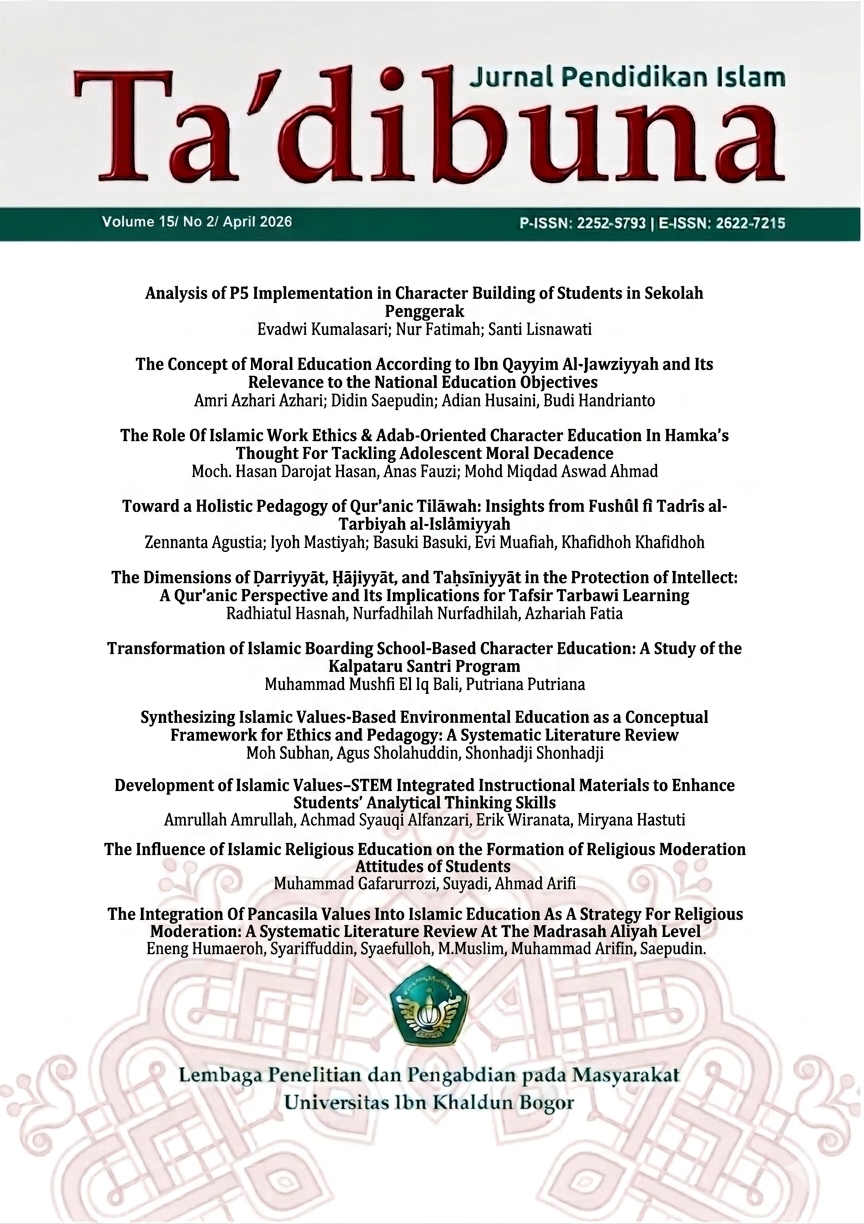
The Dimensions of Ḍarriyyāt, Ḥājiyyāt, and Taḥsīniyyāt in the Protection of Intellect: A Qur’anic Perspective and Its Implications for Tafsir Tarbawi Learning
DOI:
https://doi.org/10.32832/tadibuna.v15i2.21589Keywords:
Dharuri, Haji, Maqasid al-shari'ah, Interpretasi Tarbawi, TahsiniAbstract
The protection and fulfillment of intellectual needs are part of maqaṣid al-shari’ah, which encompasses three levels of importance: dharuri, hajji, and tahsini. This article aims to examine how this concept, from the perspective of the Qur’an, is implemented in the teaching of Tafsir Tarbawi at the Faculty of Tarbiyah. Using a qualitative approach and descriptive-analytical methods, this study combines a literature review of Qur'anic verses related to reason with observations of the curriculum and teaching practices of Tafsir Tarbawi in several PTKIN Tarbiyah Faculties. The results of the study show that the protection of reason in a dharuri manner includes the prohibition of intoxicants, in a hajji manner includes strengthening the intellectual capacity of students, and in a tahsini manner includes the development of a culture of critical thinking and aesthetic reasoning in interpreting the Qur'an. The implication of these findings is the importance of maqaṣid-based Tafsir Tarbawi learning to produce professional teachers who are able to transform Islamic values rationally, moderately, and contextually. Integration with Islamic education theory and constructivism strengthens the transformative character of learning, thereby encouraging the emergence of Muslim educators who are rational, moderate, and contextual.
Downloads
Published
How to Cite
Issue
Section
License
Copyright (c) 2026 Ta'dibuna: Jurnal Pendidikan Islam

This work is licensed under a Creative Commons Attribution-ShareAlike 4.0 International License.
Penulis memberikan hak cipta karyanya kepada jurnal yang dilisensikan dengan CC-BY-SA or The Creative Commons Attribution–ShareAlike License yang memungkinkan orang lain untuk menggunakan karya dengan pengakuan kepengarangan karya dan publikasi awal dalam jurnal ini.